
Horology’s most humbling object was not made in Geneva. Around the turn of the last century, Greek sponge divers working off a rocky speck between Crete and the Peloponnese hauled up the contents of an ancient shipwreck, among them a lump of corroded bronze that would be recognised, decades later, as a geared astronomical calculator built around 60 BCE.
The Antikythera mechanism could predict eclipses and track celestial cycles with an accuracy that should not have existed for another millennium and a half, and it took modern science most of the twentieth century to admit as much. The physicist Derek de Solla Price spent decades coaxing out its secrets, and only CT scanning in the 2000s revealed the full extent of its gear train. Every complicated watch ever made is, in some sense, a footnote to it.
Enter, improbably, Hublot. The brand that scandalised the industry in 1980 by putting a gold case on a rubber strap is nobody’s idea of an obvious custodian for ancient Greek astronomy, and yet its claim on the mechanism is the longest-running in modern watchmaking.

In 2011, R&D chief Mathias Buttet, who had arrived at the manufacture with the remnants of the complications specialist BNB Concept, unveiled a calibre that shrank the mechanism’s functions to wristwatch scale. Tellingly, it was first shown not at a watch fair but at the Musée des Arts et Métiers in Paris, as part of an exhibition on the original artefact.
The MP-04 Antikythera concept watch followed, then the more wearable Antikythera SunMoon, and since 2014, the brand’s Xplorations department has spent weeks every year at the wreck site itself, serving as the technical arm of the archaeological dive teams.
The 2026 chapter adds a documentary, an 18-day expedition filmed with Swiss content creator Anil Brancaleoni and released on both his channel and Hublot’s. It also puts the watches back under the spotlight, complete with fresh spec sheets and, for the SunMoon pair, prices attached. The trio rewards a closer look, because nothing else in the catalogue explains what Hublot thinks it is quite so well.
The MP-04, A Computer You Wind
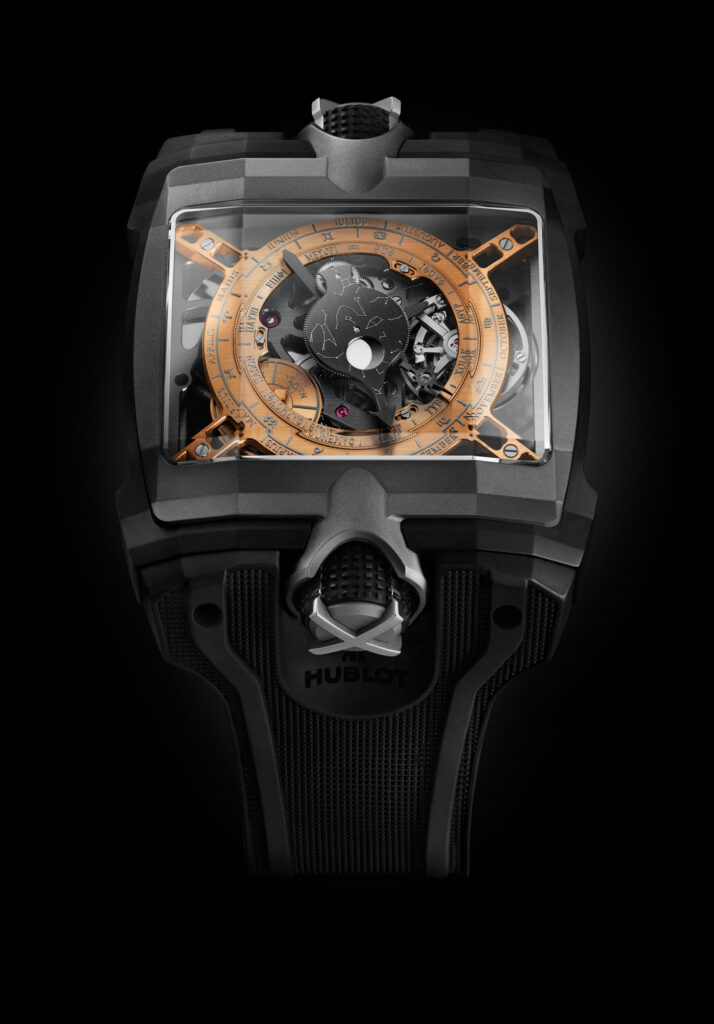
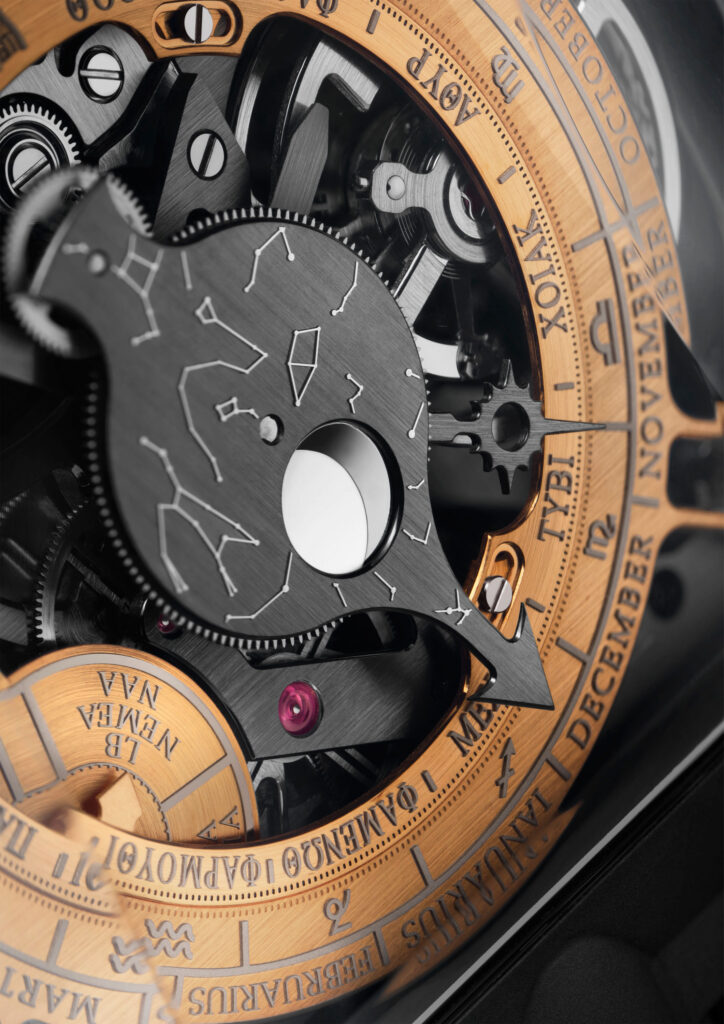
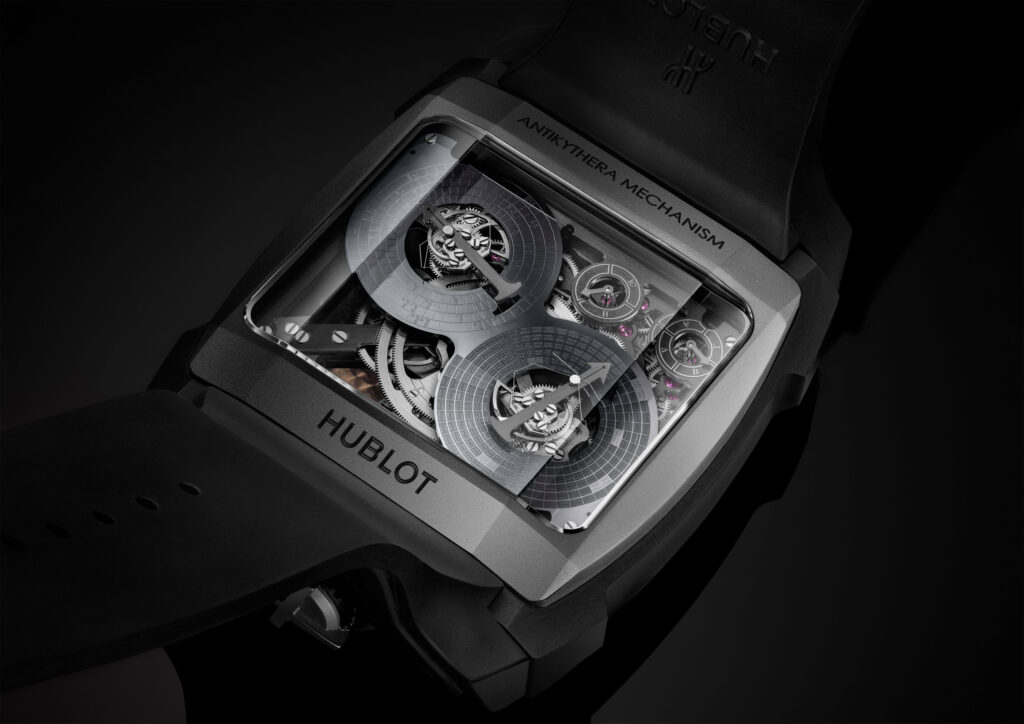
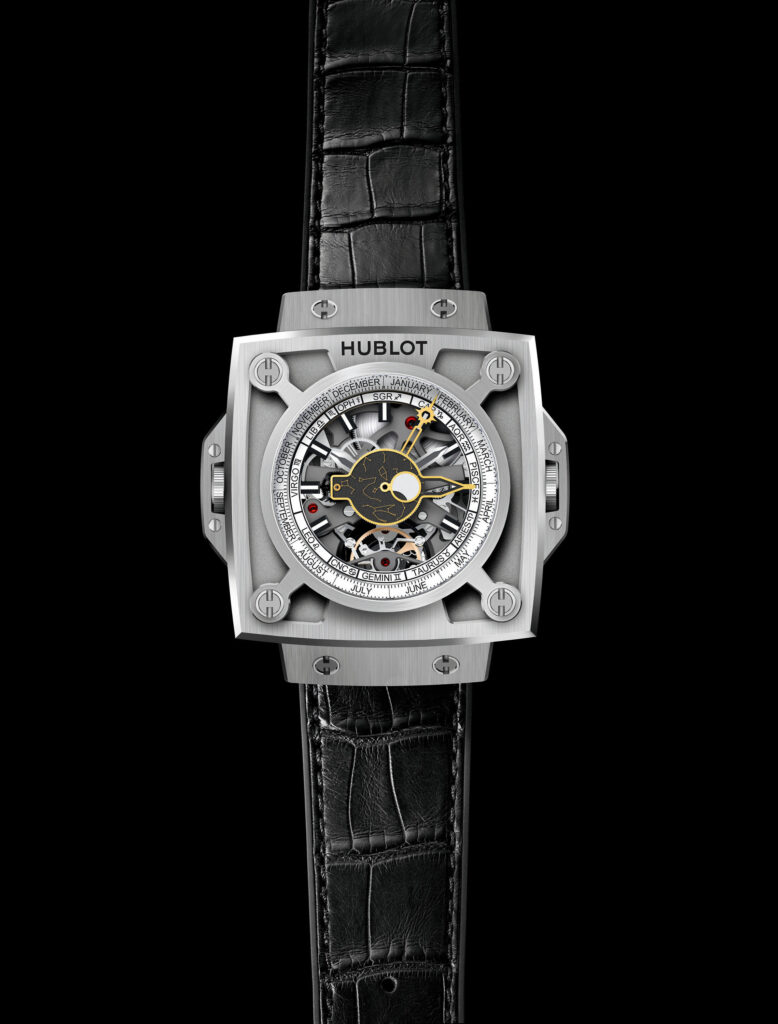
The MP-04 Antikythera remains one of the strangest and most intellectually serious watches of its era. Within a 45.5mm titanium case, 16.5mm thick, a manual-winding tourbillon movement reproduces the ancient machine’s repertoire: the 19-year Metonic cycle of 235 lunations, the 76-year Callippic cycle, the Saros cycle of 223 lunations that allows the prediction of solar and lunar eclipses, and the 54-year Exeligmos cycle that refines them.
To these it adds the Egyptian calendar of 360 days plus five epagomenal ones, the positions of the sun and moon in the zodiac with a correction for the moon’s irregular speed, and the calendar of the Panhellenic Games, quite possibly the least useful complication ever put on a wrist and all the more charming for it. Nobody needs any of this, which is rather the point. The MP-04 was built to prove a 2,000-year-old genius could be honoured at 3Hz, with a 105-hour power reserve thrown in.
SunMoon, the Myth Made (almost) Wearable
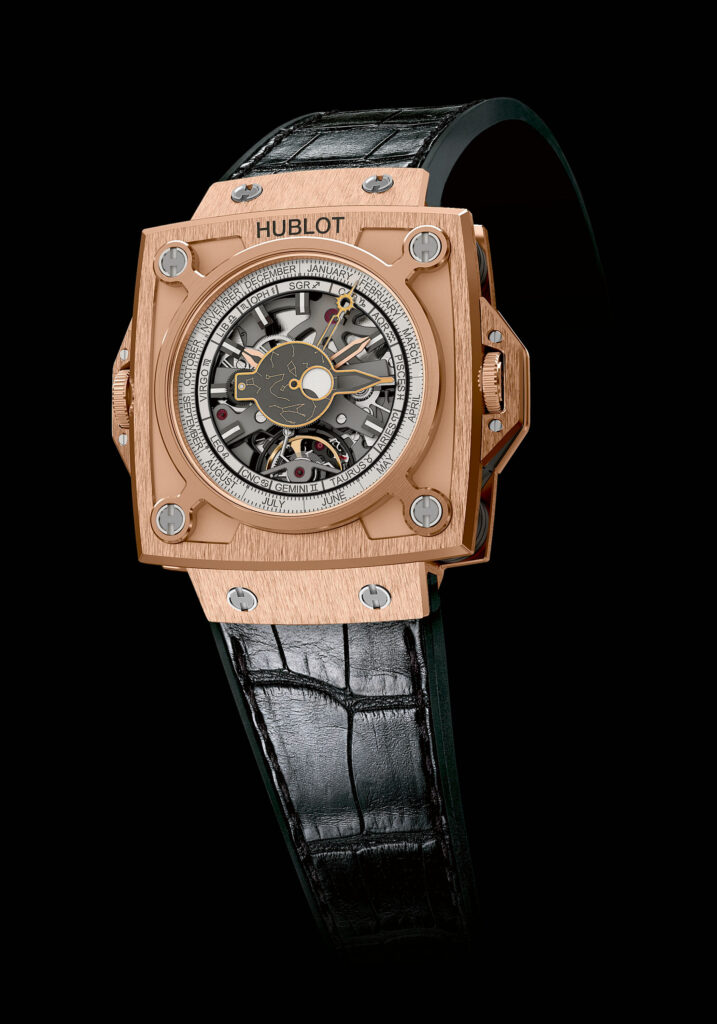
The MP-08 Antikythera SunMoon distils that madness into something you could conceivably live with, allowing for a 49 mm case that stands 20.8 mm off the wrist. Its manual-winding HUB9008 tourbillon runs 295 components and 30 jewels, keeps the 105-hour reserve, and focuses on the mechanism’s most poetic party trick: displays for the sun and the moon, the synodic moon phase, and the true zodiacal sign for any date, corrected for the precession of the equinoxes, the slow wobble of the Earth’s axis that most zodiac-adjacent watches politely ignore.
Two executions are offered, each limited to 20 pieces. One arrives in titanium, satin-finished, polished and microblasted in the house manner, while the other is cast in King Gold, Hublot’s proprietary alloy fused with platinum for a warmer, harder red. Both wear black rubber and gummy alligator, because some house codes survive even antiquity.
The dives are the point
What separates this from the usual heritage cosplay is that Hublot keeps showing up. The Xplorations team has designed underwater drones to detect artefacts still buried in the sediment, works alongside the archaeologists rather than above them, and shares its downtime with the island’s roughly twenty residents. The same department contributes to the ESA’s ExoMars programme, which makes for a pleasingly absurd range of business, from the Aegean seabed to Martian orbit.
Buttet frames it simply: every movement is a statement that time deserves a bold and creative approach. The documentary, fronted by a YouTuber rather than a brand ambassador in a blazer, suggests Hublot also knows exactly which audience still gets goosebumps from a 2,000-year-old gear train.
Rather than borrowing history, Hublot keeps hauling it back to the surface. The Antikythera watches are unwearable for most, unaffordable for nearly all, and entirely necessary, because they argue that watchmaking’s future and its deepest past run on the same gears. On this evidence, the argument holds water rather better than the wreck did.