
If one had to describe the novelties of Cartier at Watches and Wonders 2026, it would be through shape: square, curved, rectangular, oval, and at times entirely irregular. More than simply revisiting familiar designs, Cartier’s latest releases demonstrate how deeply form remains embedded in the maison’s watchmaking language.
This year’s collection moves from streamlined reinterpretations like the returning Roadster to more expressive creations such as the Clous de Paris Baignoire, and the stylised Myst. At the same time, the Maison is also pushing technical development through shaped movements and newly engineered bracelets. Taken together, the lineup reinforces Cartier’s longstanding position as the industry’s definitive watchmaker of shapes.
Streamlined Forms
Among the many directions Cartier explores this year, some of the strongest are found in watches shaped by aesthetics and technical mastery. Both the Santos-Dumont and the returning Roadster revisit familiar designs, emphasising proportion and tactile detail.
The Santos-Dumont returns with a stronger emphasis on texture and materials, most notably through a gold-flecked obsidian dial that immediately distinguishes the watch from previous iterations. Sourced from volcanic stone sourced in Mexico, the material contains tiny air bubbles that create iridescent reflections beneath the surface. Its wafer-thin construction at just 0.3 mm makes the material exceptionally difficult to work with.
Yet it allows the dial to reveal subtle iridescent reflections and adds a layer of visual complexity to the model’s otherwise restrained look. The gilded aesthetic extends to the Roman numerals long associated with Cartier Santos, as well as the hands, and the crown that wraps the blue cabochon beautifully. Just as compelling as the dial is the bracelet, which offers another demonstration of Cartier’s craftsmanship. Composed of 394 individual links measuring just 1.15 mm thick, it delivers remarkable flexibility despite its intricate construction.
The return of the Roadster feels less surprising than it does overdue. Long one of the more unconventional designs in Cartier’s modern catalogue, the watch reappears for 2026 since its debut 24 years ago with a softened visual complexity from those of earlier versions. The changes are subtle but effective. Four rivets on the bezel sharpen the watch’s visual presence without adding unnecessary complexity.
The signature date magnifier continues to reference automotive headlights, preserving one of the model’s most distinctive cues. Elsewhere, the crystal and crown have been more carefully integrated into the case architecture, giving the Roadster a cleaner profile overall. Perhaps the biggest success of the new Roadster is that it still looks unmistakably like a Roadster. Available in medium and large sizes, the collection retains the dial architecture that made the original so distinctive, from its circular patterning to its Roman numerals and railroad minute track.

Ornamental Shapes
Some watches are designed to tell time; others are designed to be looked at. The latest Baignoire and Myst de Cartier belong firmly in the latter category, approaching watchmaking through the lens of texture, stone-setting, and decorative craftsmanship.
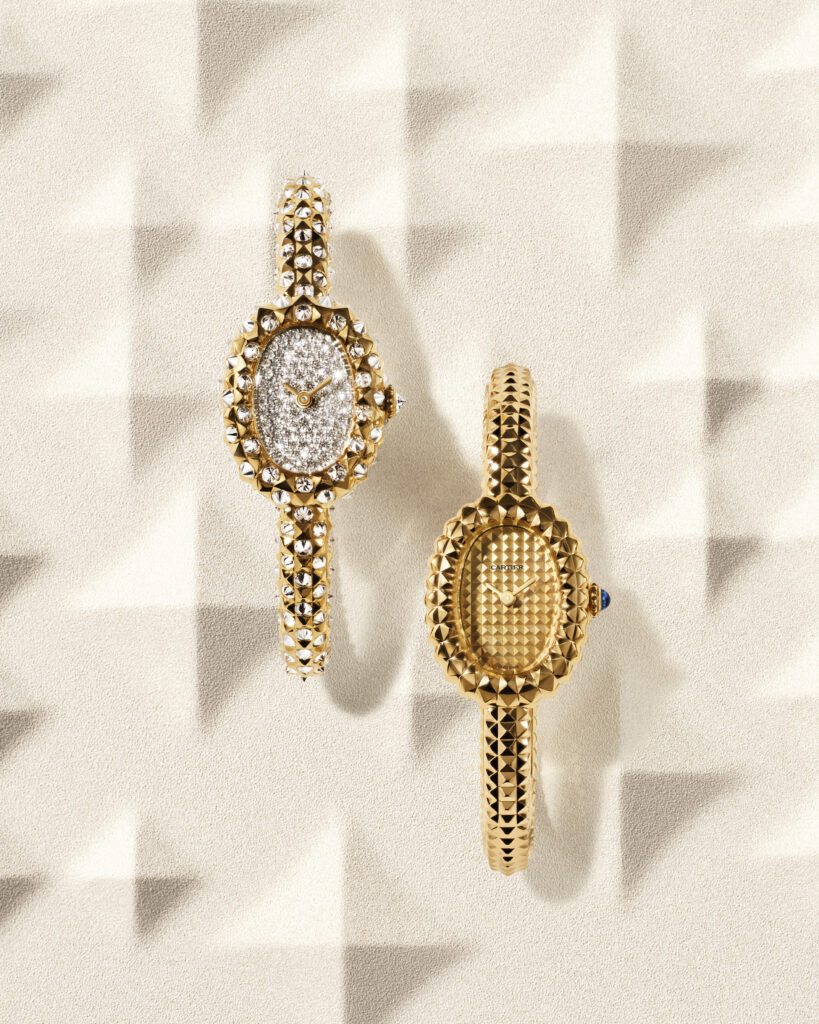
The latest Baignoire takes the bangle interpretation introduced in 2023 and gives it an entirely different character by applying the Clou de Paris motif. Rather than confining the pattern to a single element, Cartier extends it across the bracelet, case, and dial, creating a continuous surface treatment that follows the watch’s oval form. To accommodate the curved architecture, the motif’s proportions were reworked, while an inverted diamond-setting and hand-finishing helped preserve its relief and definition.
Cartier offers the watch in two yellow gold configurations, both powered by a quartz movement. One remains focused on the Clou de Paris motif and a golden dial, while the other introduces 171 brilliant-cut diamonds totalling 4.70 carats across the case and bangle, alongside a dial set with 100 brilliant-cut diamonds. Available in bracelet sizes 15 and 16, it demonstrates how the motif can accommodate gem-setting without losing its underlying structure.
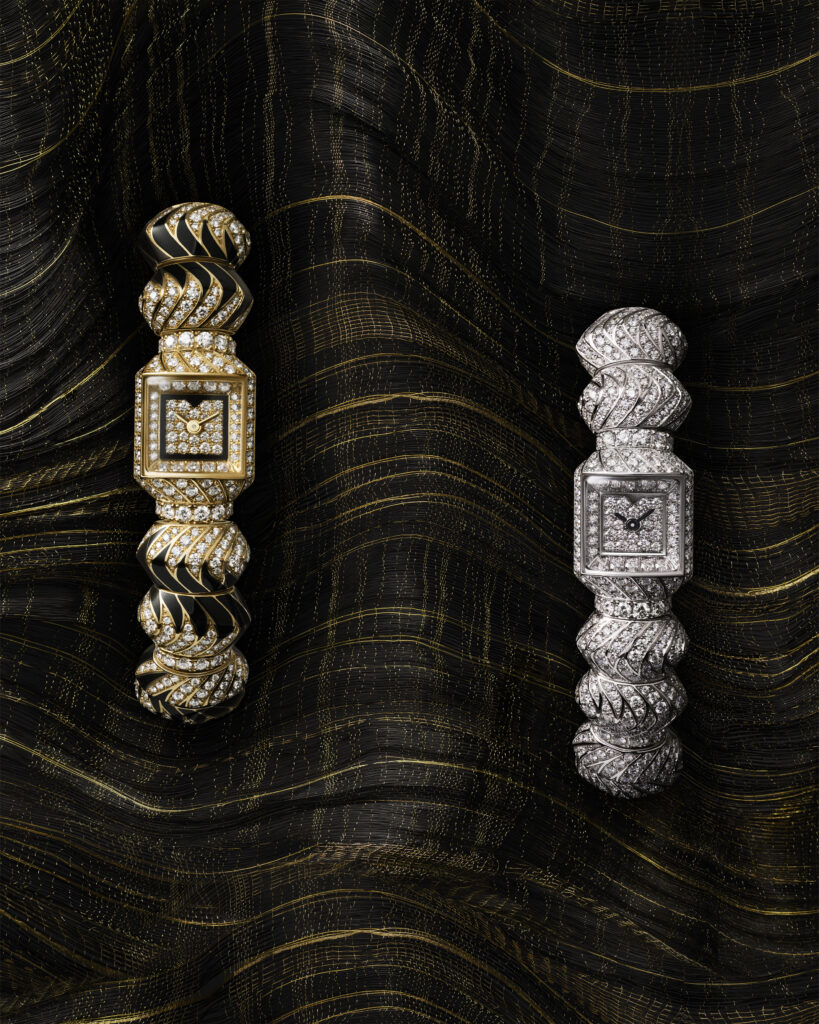
The Myst de Cartier, meanwhile, is built around a construction that deliberately obscures how the watch is worn. Composed of lacquered and pavé-set elements threaded onto a flexible articulated bracelet, it dispenses with a visible clasp altogether. Developed with the expertise of Cartier’s Maison des Métiers d’Art, the bracelet combines engineering and decoration in equal measure, with bead-setting using diamonds of varying sizes requiring around 30 hours of work and black lacquer accents painted individually by hand.
The watch is offered in yellow and white gold. The former features 634 brilliant-cut diamonds totalling 6.13 carats across the case and bracelet, while the latter increases the count to 986 diamonds weighing 9.17 carats. Both versions pair their gem-set construction with snow-set diamond dials framed by onyx, concealing a considerable amount of technical development beneath their jewellery-like appearance.
Engineering the Irregular
Few brands have treated non-round watches as seriously as Cartier. That commitment is perhaps most visible through Cartier Privé, the annual programme dedicated to revisiting some of the maison’s most significant designs. Now entering its tenth edition, the series continues to explore shapes that sit outside the conventions of contemporary watchmaking, often using them as a starting point for technical and artistic experimentation.
The Crash is a case in point. Rather than simply skeletonising an existing movement, Cartier developed the manually wound 1967 MC specifically around the watch’s distorted profile. As a result, the calibre does not merely fit inside the case; it actively follows its contours, with bridges stretched and shaped to echo the asymmetry that has defined the Crash since its debut in 1967.
The Roman numerals play a dual role, functioning as both hour markers and structural bridges within the movement itself. Each is hammered by hand using a traditional finishing technique that requires nearly two hours of work per piece. Housed within a 45.34 mm by 25.18 mm case and paired with a semi-matt burgundy alligator strap, the Crash Squelette is limited to 150 examples and remains one of the more unusual expressions of skeletonisation currently in production.
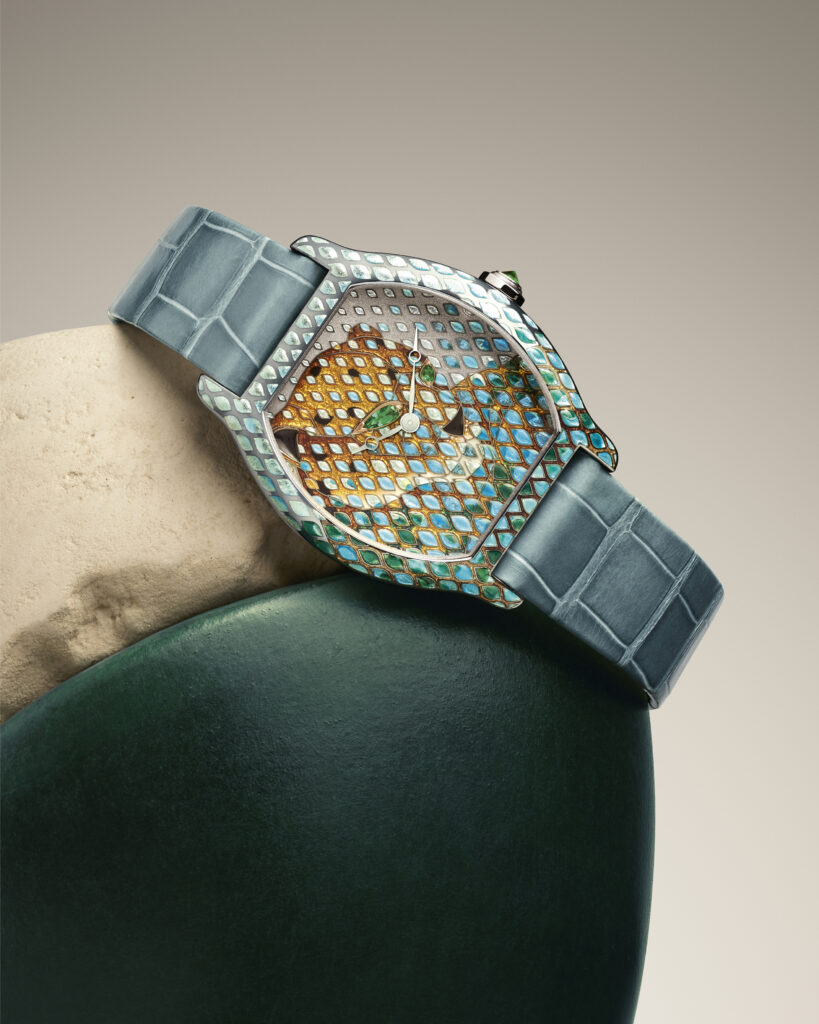
The Tortue Panthère Metiers d’’Art takes a different route. While the Crash explores mechanical adaptation, the latest Tortue focuses on decorative craft, using its curved case as a framework for one of Cartier’s most familiar symbols: the panthére. Rather than confining the scene to the dial, Cartier extends it onto the case middle, allowing the composition to unfold across multiple surfaces.
Much of that work was carried out at Cartier’s Maison des Métiers d’Art in Switzerland. Using champlevé enamel, artisans created varying levels of depth between the panthére and the surrounding rainfall, employing more than 15 enamel tones and over 36 firings in the process. The dial alone requires approximately 80 hours of enamelling, while the case accounts for another 50. Produced in editions of 100 pieces each, the watch is available in white gold with emerald-set eyes or yellow gold with tsavorite-set eyes.