Since the early 20th century, Cartier has built its identity not through mere embellishment, but opposition. The Maison has long introduced industrial motifs into precious objects, allowing studs, beads, and sharp geometry to punctuate watches, accessories, and jewels. Art at Cartier, has never been polite. Its depiction of beauty has always flirted with disruption.
Clash de Cartier makes that tension its central thesis. The collection is conceived as a clash of design codes: softness against sharpness, heritage against modernity, artistry against mechanics. All the distinct pieces feel simultaneously punk in spirit and impeccably exquisite in execution.
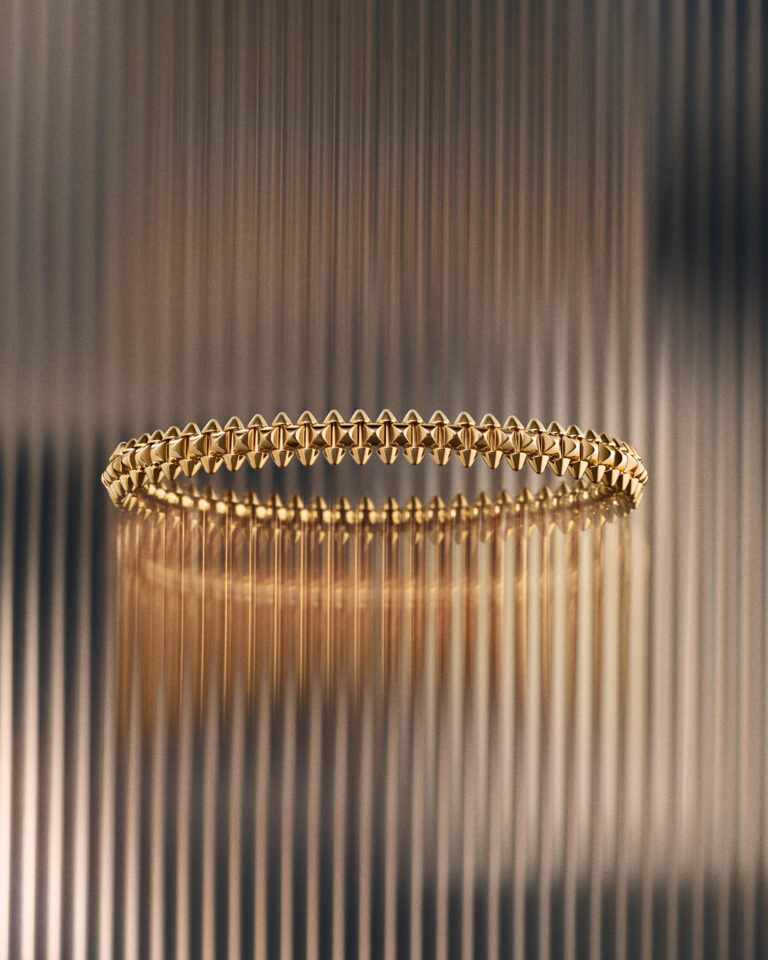
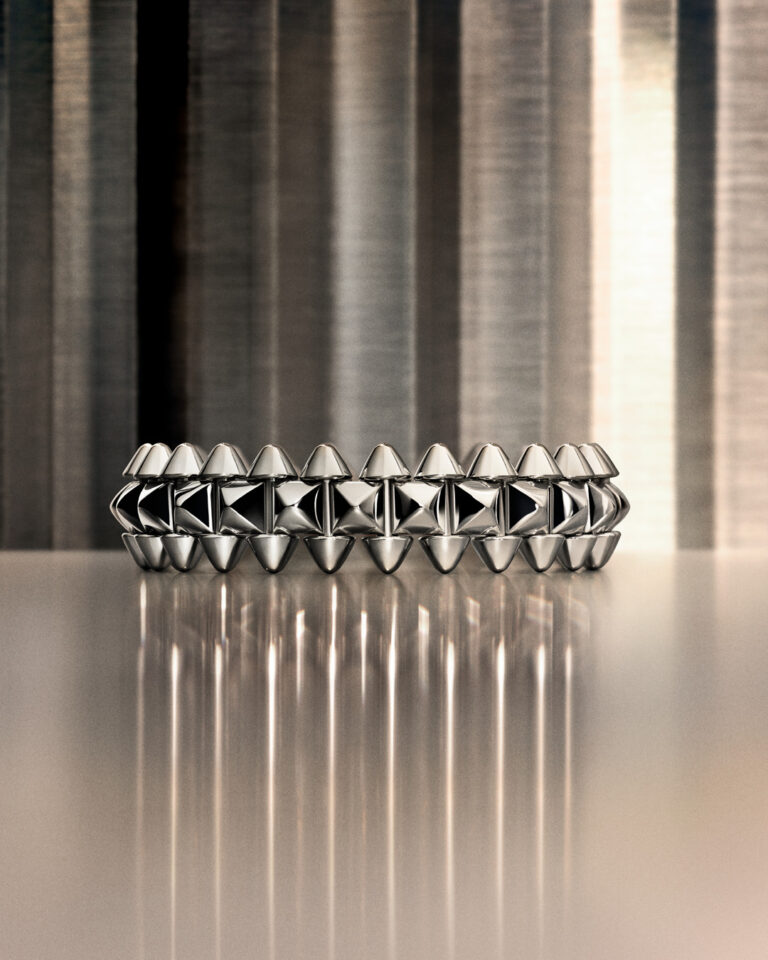
Anchoring the collection is a distinctive studded mesh, composed of three historic elements. Rounded picots bring softness and rhythm; smooth boules introduce volume; angular clous carrés inject a graphic edge, each belonging to a different visual and cultural lexicon. Fused together, they form a single, cranté structure—powerful, architectural, and unmistakably Cartier.
The clash extends beyond appearance into construction. Defined by movement, necklaces, bracelets, rings, and earrings are entirely flexible, engineered from hundreds of individual components, numbering up to 600 in some pieces. All elements remain connected yet free to move, allowing the jewellery to follow the body rather than constrain it.
To achieve this, Cartier draws on dual forms of expertise. Traditional lost-wax casting grounds the collection in high jewellery savoir-faire, while high-precision machining ensures absolute accuracy during assembly. Polished by hand, each element carries comfort and durability. When worn, the jewellery generates a subtle delicate vibration—and even a faint sound—carefully calibrated during the creation process.
This is where the punk attitude of Clash de Cartier reveals its true sophistication. The studs suggest defiance, yet the sensation on the skin is soft. The visual aggression of spikes is countered by a supple, almost sensual wear. It’s a trick of the senses that gives the illusion of masterful rebellion.
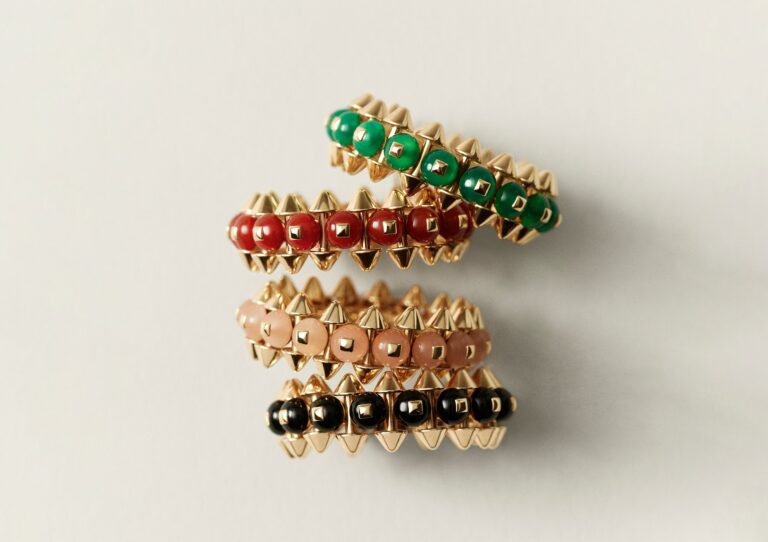
The latest iterations of the collection deepen this dialogue through material and scale. For the first time, entirely flexible necklaces and bracelets are rendered in yellow gold, introducing warmth and classic preciousness to the collection’s industrial vocabulary.
Colour enters the conversation with equal consciousness. Onyx, red-dyed agate, green-dyed agate, and pink chalcedony are integrated as hard-stone beads, interspersed with rose gold studs. Each bead is aligned to the millimetre and graded according to strict colour charts to ensure harmony within contrast. Pierced and secured with clou de Paris nails, these versions contain twice as many components as their all-gold counterparts—amplifying both technical complexity and visual impact.
Volume, too, becomes a form of expression. Extra-large designs widen the mesh and intensify the presence of the studs, particularly in bracelets, necklaces, and three-finger rings. Despite their scale, flexibility remains paramount. Even at its boldest, Clash de Cartier prioritises comfort and wearability.
This philosophy extends to adjustability and multi-wear design. Earrings in rose or white gold are composed of two flexible lines that transform depending on how they are worn—on the front and back of the ear or solely on the front—allowing the wearer to modulate the piece’s attitude. Luxury, here, is defined by freedom.
Rooted in Cartier’s experiments of the 1920s and 1930s, Clash de Cartier does not quote the Maison’s past but re-engineers it. Studs and beads once used as decorative punctuation are transformed into a moving system, one that speaks to a contemporary, urban, and gender-fluid approach to jewellery.
True to the Masion’s spirit, punk is not noise, but intent. Through a deliberate clash of codes, Cartier creates jewellery that is at once assertive and refined—objects that move, resonate, and challenge the idea of what luxury is meant to be.