
A cocktail is remembered not for its first sip, but for what lingers after, the finish that settles long after the glass is set down.
Across cultures, this idea of aftertaste defines the experience. In Japan, the precision of a highball lies in its clarity and restraint, leaving a clean, almost weightless impression. In Latin America, Caipirinha waltzes between sharpness and sweetness in a way that plays a game of hide-and-seek on the palate. Even in Europe, where aperitifs such as the Aperol Spritz are designed to open the evening, it is their gentle bitterness that refuses to say goodbye.
Cocktail culture, in all its diversity, ultimately returns to the same principle: what remains is more important than what arrives. This notion of lingering sensation finds a parallel in the Piaget Cocktail collection, where jewellery is conceived as an ambrosial aftereffect.
Echoing the 19th century’s golden age of mixology, when drink-making became an art of balance and precision, the Maison cultivates jewellery as an exercise in disciplined harmony. This is achieved not for its initial flourish, but for the visceral sensory it leaves behind.
Comprised of necklaces, earring, and rings, the collection encompasses a wide variety of vivid gemstones and dazzling diamonds. For the Olorra necklace, five intensely hued Colombian emeralds totalling 40.67 carats, are the star of the show, while custom-cut turquoise and lapis lazuli stones alternate with diamonds to form geometric pendants. Emeralds similarly adorn the Solenara necklace, as well as the Tutti Kanya, which is a choral creation that features an imposing 30.33-carat engraved emerald from Zambia. All around it, flowers, leaves and berries carved from rubies, sapphires and emeralds bloom in corollas. Meanwhile, the Tellura sparkles with 30 uniquely shaped diamonds, in an interplay of volumes with alternating pavé scrolls and openworking that creates an impression of continuous movement.
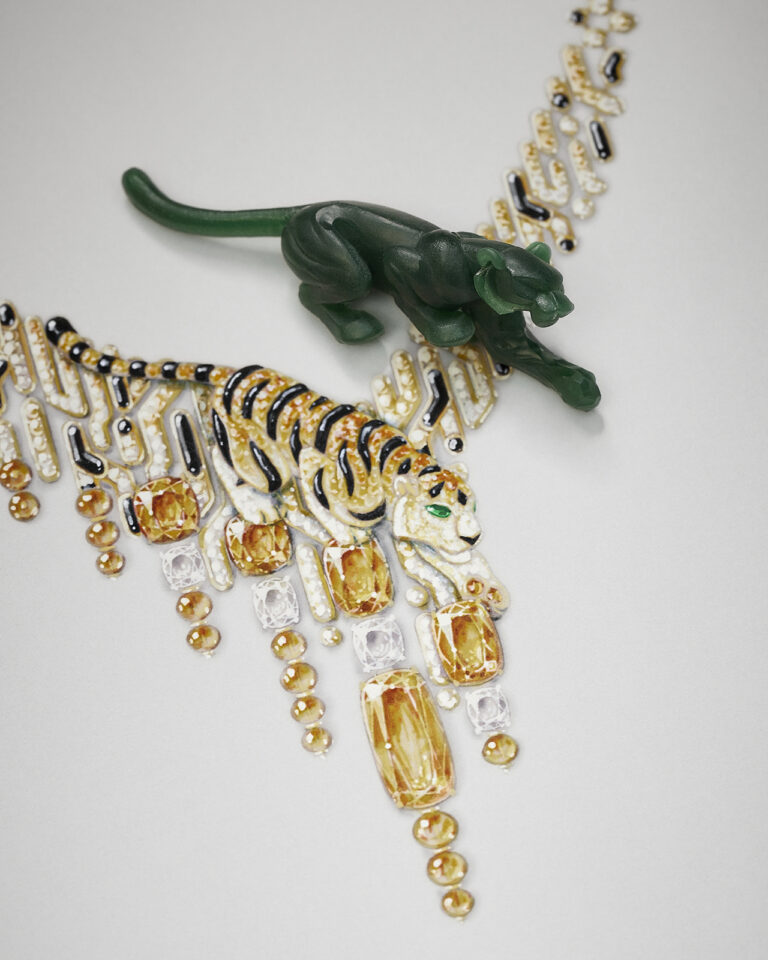
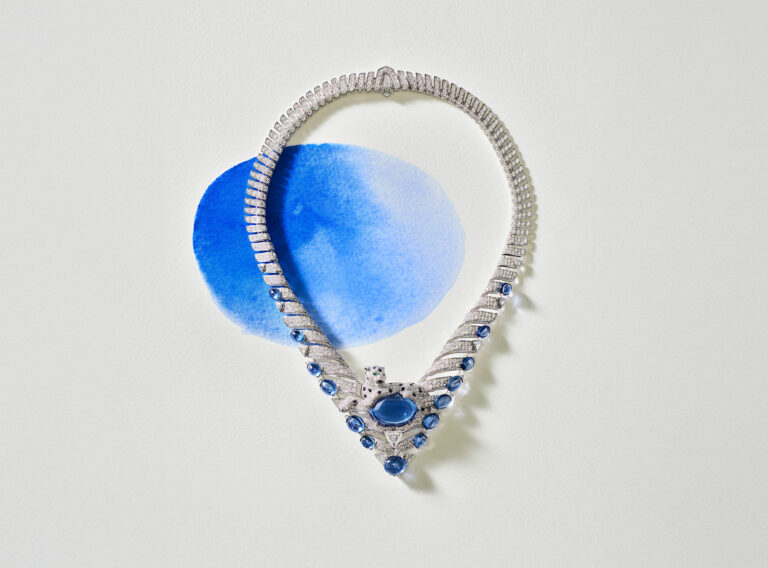
Completing the necklaces are two unique creations, one that pays tribute to the Maison’s muse, the panther, and the other celebrating its worthy companion, the tiger. For the Panthére Kentia, Cartier used a 50.13-carat cabochon-cut Ceylon sapphire as the centre stone, as well as smaller cabochons, juxtaposed with geometric lines throughout the necklace. On top of the centre stone, the regal panther reclines, balancing the tension between curves and graphic lines. Haryma, on the other hand is a striking assembly of five exceptional imperial topazes weighing 28.04 carats, as well as garnets and white, yellow, and orange diamonds. With a staircase arrangement, the topazes create a dynamic effect, on which the tiger moves silently and stealthily.
One distinct model—the Pyra—is a contemporary earring that derives inspiration from an early 20th century tiara. Mimicking raindrops falling from the sky and scattering through the wearer’s hair, it highlights 6.85 carats of orange diamonds and white diamonds. However, the piece is not one-dimensional as it can also be a brooch or hair accessory. Versatility, after all, is an iconic feature of Cartier’s tradition of modular jewellery.
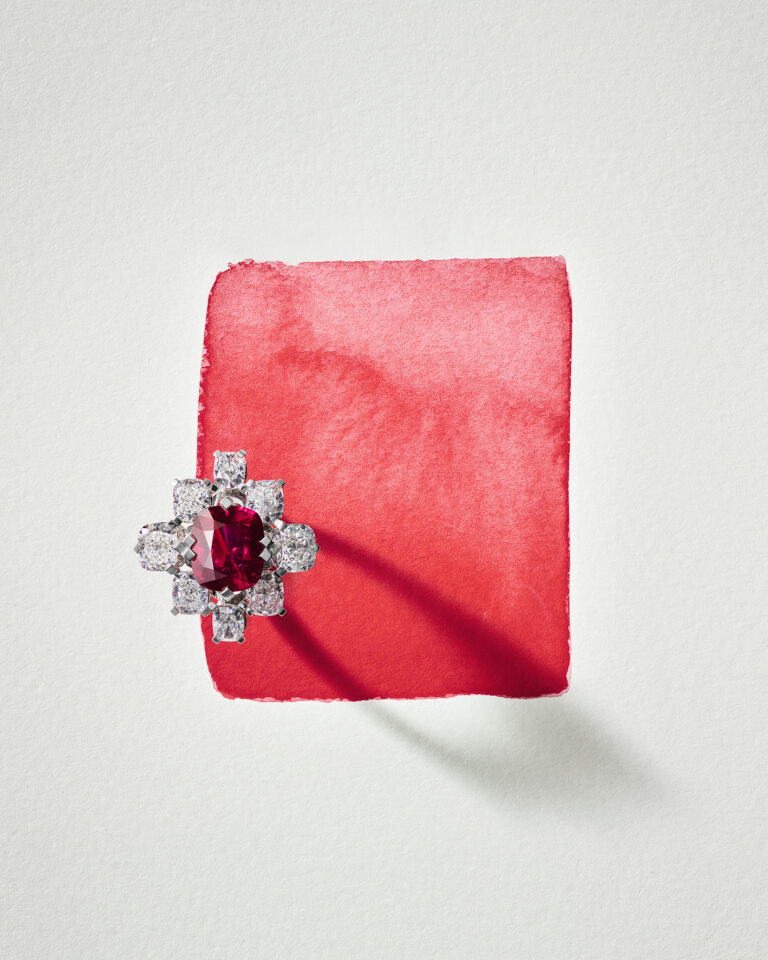
To wrap up the collection, the Maison also presents eight rings, showcasing eight stones whose brilliance, shape and colour have opened up new territories of craftsmanship and style. The Specula is a ring that can be worn in two different ways. Fitted with a pair of exceptional triangular diamonds totalling 6.44 carats, the modular structure has a bold concept of two rings making a whole. Similarly, another original interpretation of the classic Toi & Moi is the Kinkō, with its two gems—one green, one blue—that pay tribute to Louis Cartier’s signature combination dubbed ‘peacock motif,’ while the Amberis, with its 7.09 cognac-coloured diamond, upholds the beautiful radiance of coloured diamonds. Completing the design are brown diamond cabochons separated by lines of square- and brilliant-cut white diamonds on the ring’s shank.
A wonderful display of Cartier’s mastery of gemstones and its unparalleled savoir-faire, the Le Chœur des Pierres is truly a collection worth knowing and coveting.