
For almost 70 years, Rolex has forged a privileged relationship with the world of yachting, beginning in the late 1950s, when it formed a first alliance with the New York Yacht Club (NYYC), founder of the America’s Cup. In the decades that followed, Rolex established strong ties with other influential yacht clubs across the globe. Inspired by the camaraderie and enthusiasm shared by elite sailors and competitors alike, the brand developed the Oyster Perpetual Yacht-Master range, comprised of tool watches equipped with technical features and specific functions designed for yacht racing.
This year, Rolex continues its legacy in creating dependable regatta instruments by introducing the new Oyster Perpetual Yacht-Master II. Now simplified and modernised, it features an entirely redesigned countdown function that can more effectively assist sailors during the critical start sequence of races. With an improved display for enhanced legibility and easier manipulation, the countdown scale now appears on a flange, and the function is programmed and operated exclusively via the two side pushers.
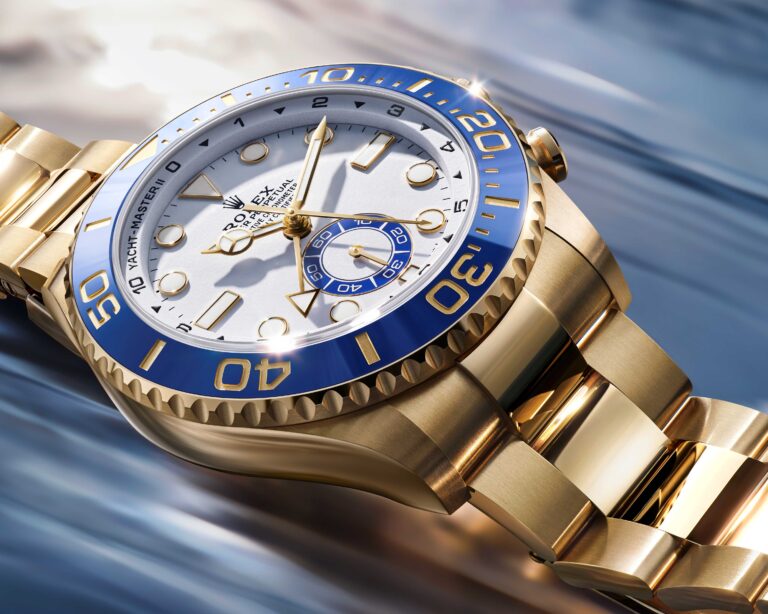
Available in Oystersteel or 18-carat yellow gold, the Oyster case of the Yacht-Master II measures 44 mm and is guaranteed waterproof to a depth of 100 metres. The bidirectional rotatable bezel is fitted with a 60-minute graduated Cerachrom insert in blue ceramic, while the dial is coated with a new white lacquer, mattified to reduce reflections. It also features applique index hour markers typical of Professional-category watches. The flange dedicated to the countdown function is positioned precisely on the middle case, an attribute for which a patent application was filed. It is graduated from 10 to 0 minutes, with the half minutes shown as triangles. For the version in Oystersteel, these markers are red, a colour also found on the hands related to the countdown function. On the right side of the case, the two pushers for programming and using the countdown function are shaped like winches, the devices used by sailors to wind a yacht’s ropes in or out. Notably, the countdown minute and seconds hands on this timepiece turn counterclockwise—a first for Rolex—making the information they display, namely time counting down towards zero, clearly readable for the wearer.
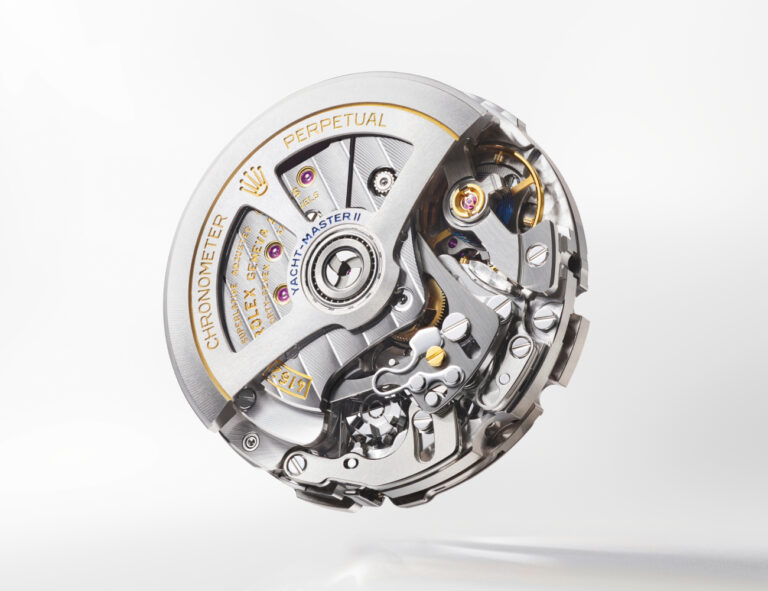
The new-generation Yacht-Master II is equipped with calibre 4162, an evolution of calibre 4161 that powered the previous version of the model. This new movement incorporates a number of Rolex’s major innovations, including the Chronergy escapement, and boasts improvements to its aesthetics such as a cut-out oscillating weight and new finishes, particularly on the bridges, which are embellished with Rolex Côtes de Genève, the brand’s reinterpretation of a well-known decoration in watchmaking. Calibre 4162 enables the Yacht-Master II to count down the time remaining before the start of a regatta via the countdown function, in addition to displaying the hours, minutes and seconds. Calibre 4162 is equipped with a self-winding system via a Perpetual rotor. Thanks to its barrel architecture and the escapement’s superior efficiency, the power reserve of this movement extends to approximately 72 hours.
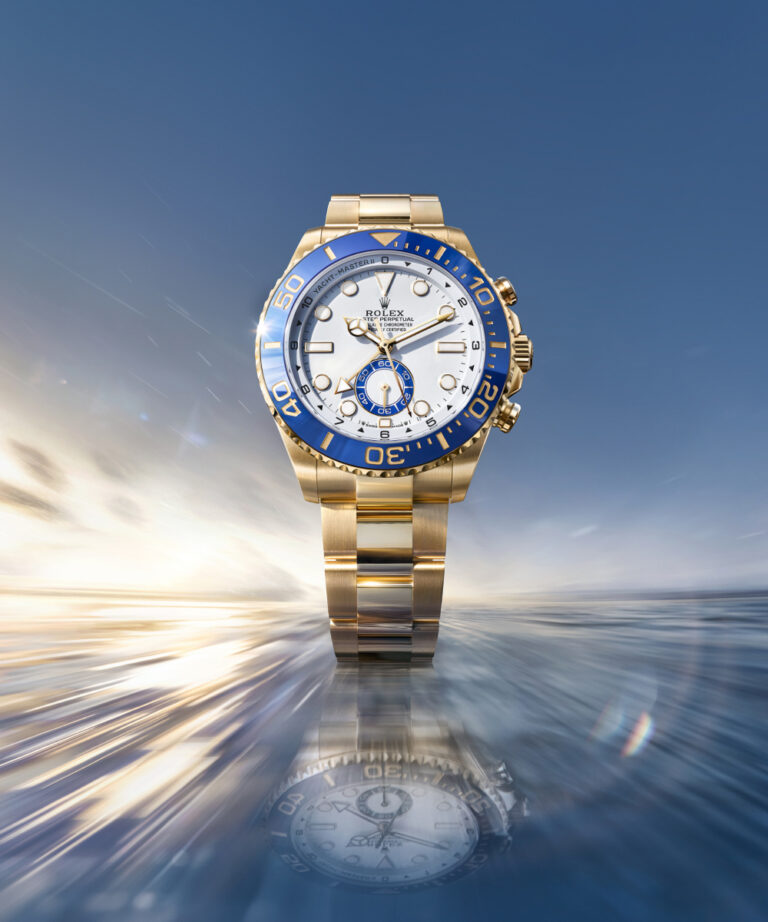
For greater harmony of the case and bracelet, the Oyster bracelet on this timepiece is slightly broader than on the previous version, and its Oysterlock clasp is slimmer. The Oyster bracelet is furnished with the Oysterlock folding safety clasp, which prevents accidental opening, and features the Easylink comfort extension link created by Rolex that allows the wearer to easily adjust the bracelet length by approximately 5 mm. On the version in 18-carat yellow gold, it includes patented ceramic inserts—designed by the brand—inside the links to help prevent premature wear and enhance its flexibility on the wrist.
Crafted specifically for regatta starting sequences, the Yacht-Master II is an innovative tool that allows sailors to adopt the best possible strategy for the critical start phase of a race. This nautical instrument, like all Rolex watches, carries the Superlative Chronometer certification, with strengthened criteria since 2026, which ensures excellent performance on the wrist.