
Since its inception, Franck Muller has remained dedicated to creating some of the most technically demanding timepieces in the horology sphere. Defined by mechanical artistry and a distinctive flair for design, the maison has built its reputation on balancing technical innovation with a recognisable visual identity. This approach continues with the 2026 release of the Franck Muller Vanguard Aero Revolution 3 Skeleton.
Each year, this vision is presented through the World Presentation of Haute Horlogerie (WPHH), Franck Muller’s annual showcase for trade visitors and press. Timed alongside Watches and Wonders Geneva, WPHH allows the maison to present its novelties on its own terms. The presentation takes place at the historic Domaine du Grand Malagny in Genthod, an 18th-century estate overlooking Lake Geneva and Mont Blanc.
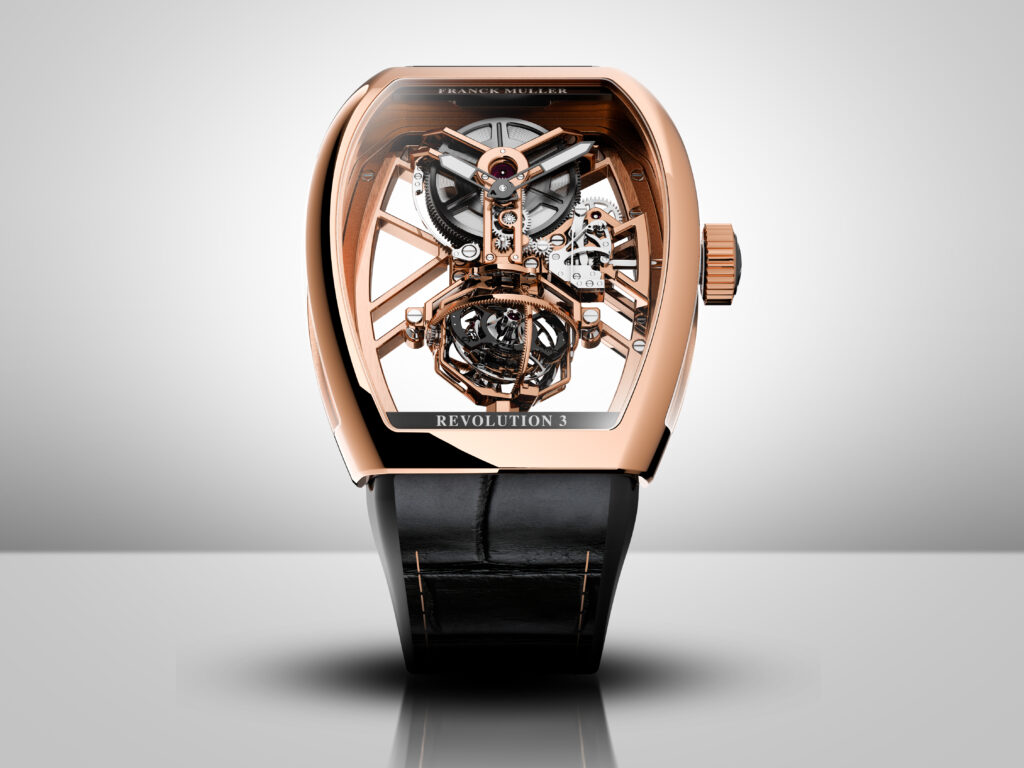
It is here that the Franck Muller Vanguard Aero Revolution 3 Skeleton made its 2026 debut, reinforcing the collection’s role as one of the boldest expressions of the maison. Rather than introducing an entirely new complication, Franck Muller reinterprets one of its most significant technical achievements in this latest Vanguard: the tri-axial tourbillon. Three highlights define this new iteration:
1. History of the Revolution 3
First introduced by the maison in 2004 with the Revolution 3, the complication became a defining milestone in contemporary haute horlogerie. At launch, it was recognised as the world’s first tri-axial tourbillon wristwatch. It expanded the traditional single-axis tourbillon into a far more complex three-dimensional regulating system.
Designed to counter gravity with greater precision, the mechanism placed the balance wheel within three concentric cages rotating on separate axes. This allowed constant positional variation and improved chronometric performance.
Beyond its technical achievement, the Revolution 3 marked a significant moment for Franck Muller’s identity as the “Master of Complications.” It demonstrated the maison’s ability in breaking the boundaries of conventional watchmaking limits. At the same time, the watch transformed an already demanding complication into a spectacle of engineering mastery.
2. Inside the Vanguard Aero Revolution 3 Skeleton
The latest Franck Muller Vanguard reinterprets this legacy through a new architectural language while preserving the technical foundation of the original tri-axial tourbillon. This piece is powered by the manually wound in-house calibre MVT FM 2031-SMR-VS-NR, developed for its openworked construction. With a remarkable 10-day power reserve, made possible by twin barrels, the movement turns the complication into the watch’s visual centre.
The balance wheel operates at 18,000 vibrations per hour, enabling the tri-axial tourbillon to maintain its intricate rotational rhythm with stability and precision. Complementing this architecture are the off-centred hands, positioned away from the central mechanism to preserve a clear and uninterrupted view of the movement.
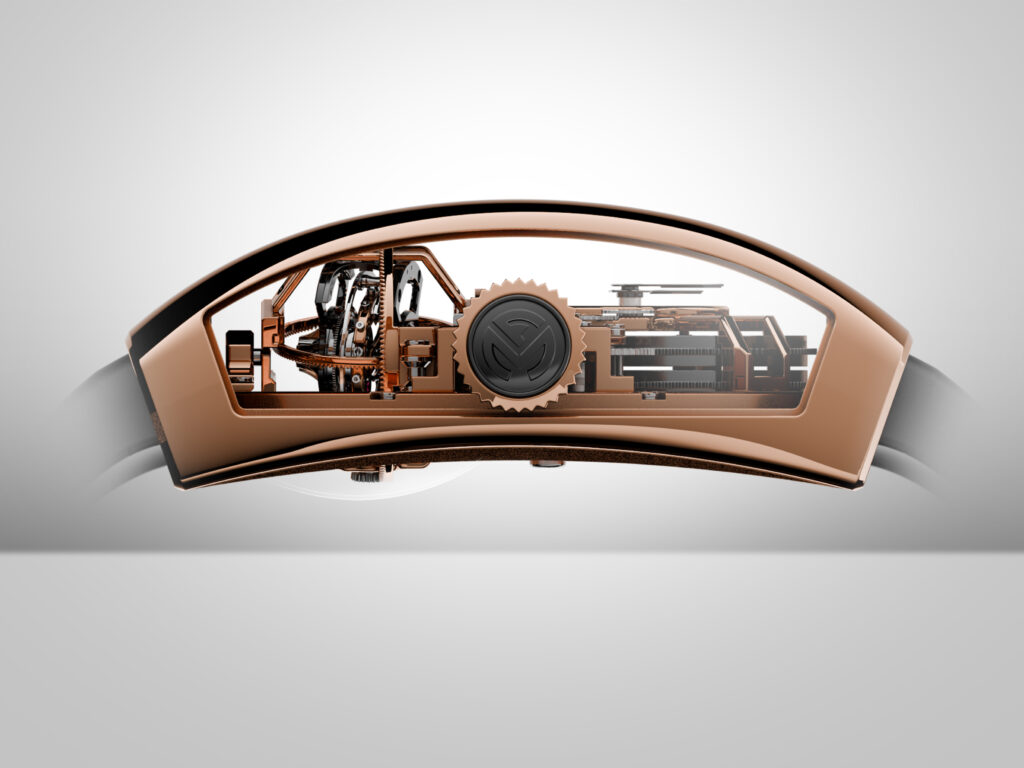
Its regulating system is built around three concentric cages rotating on separate axes, each moving at a different rhythm. The central cage rotates once every sixty seconds, while the second completes its cycle in eight minutes, and the outermost cage revolves once every hour. This continuous motion allows the balance wheel to occupy multiple positions in space while simultaneously improving chronometric precision.
To preserve its skeletonised concept, the movement is now attached directly to the caseback. Far from being merely an aesthetic feat, this architecture required a complete re-engineering of the movement’s construction. This includes the bridges, barrels, gear train, and crown system, which now integrate seamlessly with both the case and caseback.
3. The Vanguard Look, Reimagined
Staying true to the collection’s DNA, this latest interpretation of the Vanguard retains the signature Cintrée Curvex silhouette that has become synonymous with Franck Muller itself. In the Vanguard Aero Revolution 3 Skeleton, the tonneau profile is reimagined through a transparent structure that places greater emphasis on the movement within.
Rendered in 18K rose gold, the case measures 43.9 mm by 52.1 mm with a thickness of 16.45 mm. Its curved lines soften the bold proportions while ensuring comfort on the wrist. Open on all four sides and framed by sapphire crystal on both the front and back, the case offers clear views of the tri-axial tourbillon from multiple angles. Despite its minimal construction, the case maintains structural stability and water resistance up to 30 metres.
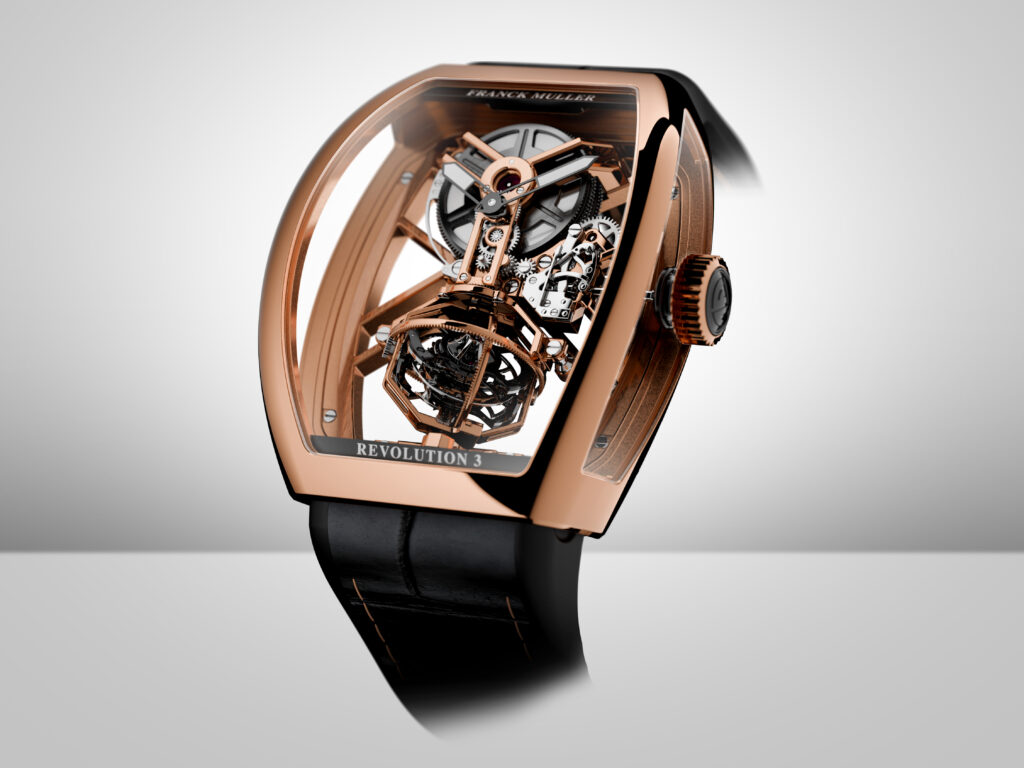
Beyond its architectural construction, attention to finishing is equally meticulous across the entire movement. The regulator assembly and bridges are enhanced with mirror polishing, while beveling sharpens the definition of the mainplate and surrounding structures. Circular satin brushing appears on the wheels and barrel cover, complemented by sunray brushing on the bearing cage and snailing on the ratchets.
Completing the design is an integrated alligator leather strap, giving the watch a dressier finish. Seamlessly fitted with hidden screws, it preserves the uninterrupted flow of the Vanguard case while enhancing both comfort and wearability. This final detail reinforces the balance between technical complexity and refined sophistication that defines the Vanguard Aero Revolution 3 Skeleton.