Roger Dubuis: Where The Magic Happens in Motion

Experience how Roger Dubuis transforms engineering into art with each skeletonized movement and meticulously finished part
Short on time? Access a brief summary.
Short on time?
Access a brief summary.
The Roger Dubuis Manufacture in Geneva is a fully-integrated centre that houses the Maison’s different watchmaking departments


The day we visited Roger Dubuis headquarters in Meyrin, Geneva, the first thing that struck us wasn’t the watches; it was the building itself. Sleek, minimalist, and full of light. The fully integrated manufacture that houses around 150 people stands as a quiet counterpoint to the brand’s expressive designs. There’s a deliberate openness to it: floor-to-ceiling glass windows, and transparent workshop partitions that seem to say, “We have nothing to hide.”


That particular philosophy comes through not only in how the artisans work, but also in how openly they welcomed us into the inner workings of what Roger Dubuis calls hyper horology. We were welcomed by Bader A., the International Retail Project Manager at Roger Dubuis, who walked us through the production process step by step, giving us access to areas rarely seen by those outside the industry. 


In its first 11 years, Roger Dubuis—founder of the eponymous brand—developed some of the most renowned complications in watchmaking

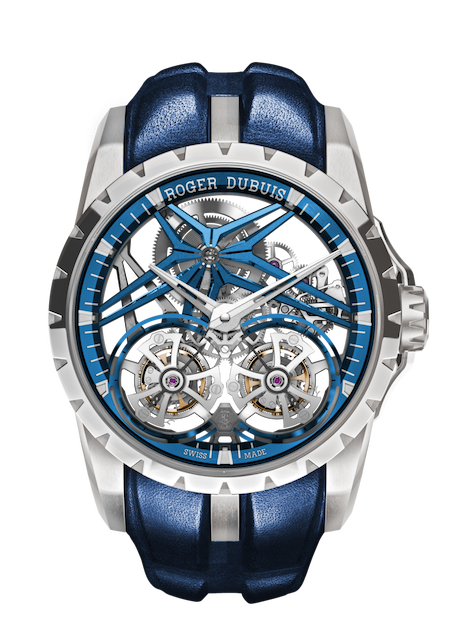
Our journey began on a small exhibition floor filled with state-of-the-art machines. Many of which, without Bader’s patient and thorough explanations, we would never have known the purpose of. Before delving deeper into the world of hyper horology, we paused before several of Roger Dubuis’ most iconic base plates, displayed in glass cabinets. They are the foundational elements behind the brand’s signature creations, including the Excalibur Double Flying Tourbillon. “This is the perfect illustration of who we are,” Bader explained.


Unlike traditional tourbillons, which are typically anchored by visible bridges, Roger Dubuis’ flying tourbillons, their signature, appear to float, free of obstruction, suspended in space. In 2005, the brand became the first to assemble a double flying tourbillon. Less as a means to improve accuracy, and more as a testament to the brand’s technical prowess. 


It takes more time, more skill, and an uncompromising approach to synchronise two rotating mechanisms within the same movement. Since 2004, the brand has embraced a fully skeletonised design philosophy, eschewing solid dials and plain materials in favour of transparency and aesthetic complexity. The result is a visual language that is instantly recognisable: bold and distinctly haute horlogerie. “This,” Bader said with quiet pride, “is what we stand for.”


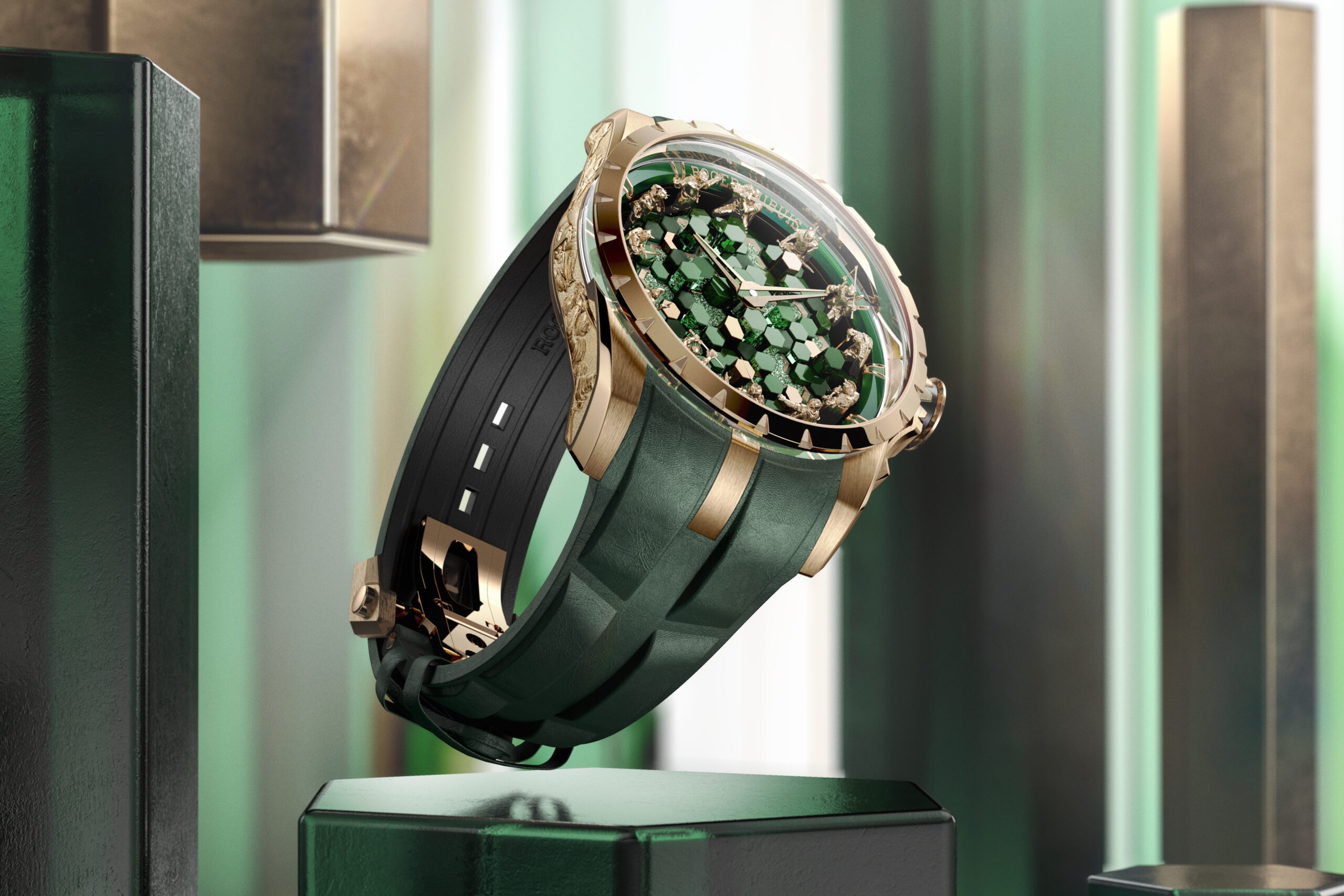
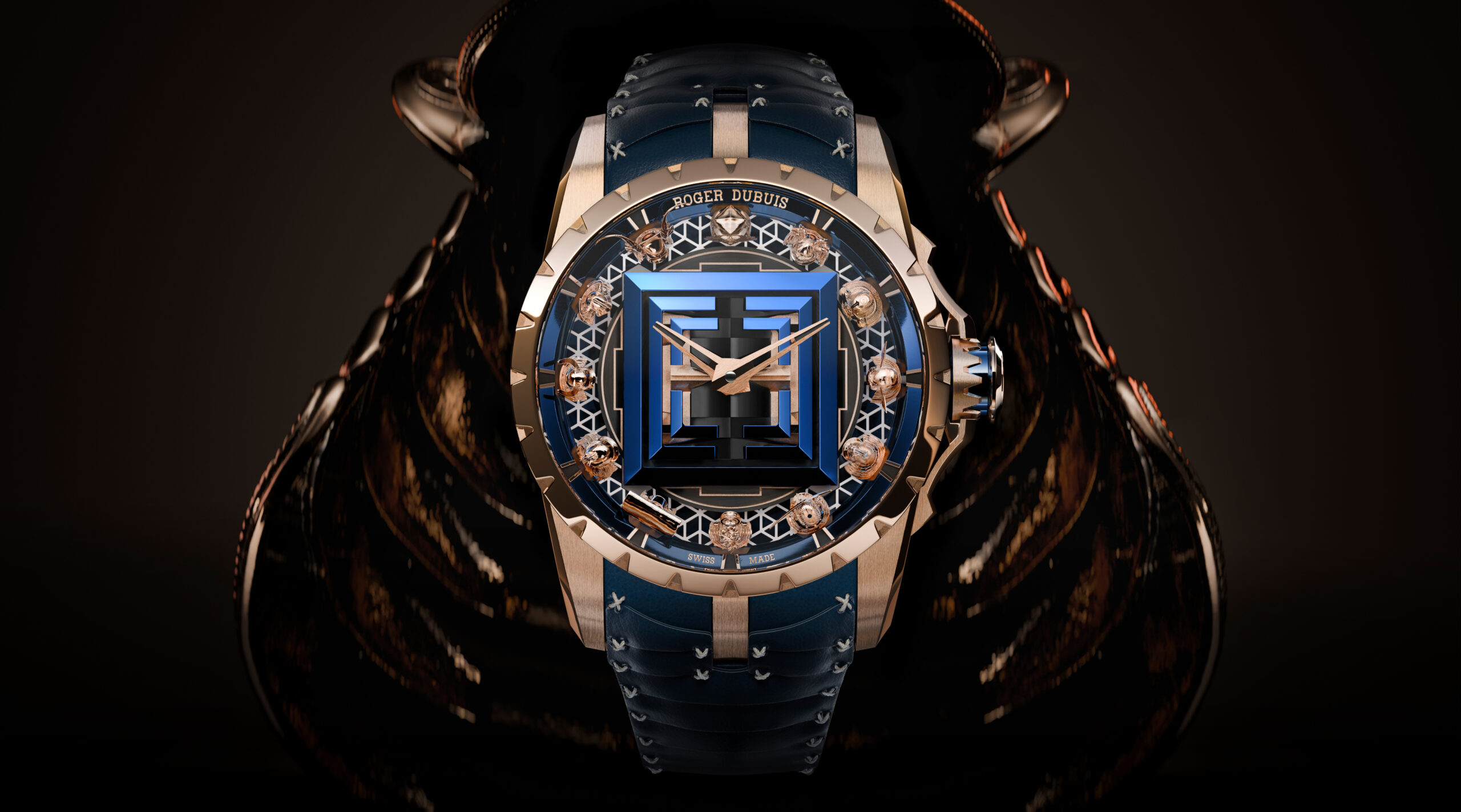
Excalibur Double Tourbillon Cobalt

As we continued the tour, Bader pointed to the discreet yet significant Poinçon de Genève stamp on one of the movements. At Roger Dubuis, this seal represents both a mark of prestige and a commitment to exceptional craftsmanship, one that extends the production timeline by nearly 40%. Among the key requirements to qualify for the seal is that every watch must be fully assembled, cased, and finished within the Canton of Geneva. Few brands can meet these demands, but Roger Dubuis consistently exceeds expectations, with over 90% of its timepieces proudly bearing the certification. 


Each Roger Dubuis timepiece undergoes an intensive series of around 88 in-house tests conducted over the course of a full week to ensure it meets the rigorous standards set by the Poinçon de Genève. While many Maisons must send their watches to the Geneva Seal office for inspection and stamping, Roger Dubuis—thanks to its long-standing commitment and proven compliance—is authorised to perform the stamping in-house.


Awarded to only around 24,000 of the 20–25 million Swiss-made watches produced annually, Poinçon de Genève imposes some of the most rigorous standards in horology


This privilege is built on mutual trust and years of consistent excellence. However, that trust is still regularly verified through audits, with up to 12 inspections a year, but thanks to the years of proven compliance, they typically only receive two. One announced in advance, and one completely unannounced, a surprise inspection. During these audits, inspectors examine every detail, verifying that all components, from the tiniest screw to the most visible bridges, are hand-decorated to the exacting principles the seal demands.


“This isn’t the work of machines,” Bader reminded us. “Every line, every surface you see, it’s done by hand.” This approach reflects the savoir-faire that the brand’s founder, Roger Dubuis, brought with him from his years at Patek Philippe, blending traditional high watchmaking with a bold, contemporary spirit. It truly exemplifies a philosophy that’s deeply rooted in the brand’s DNA; one that is still honoured until the present day.


Roger Dubuis introduced its first Double Tourbillon in 2005, linking two tourbillons with a regulating differential. This breakthrough continues to shape the brand’s evolving creations

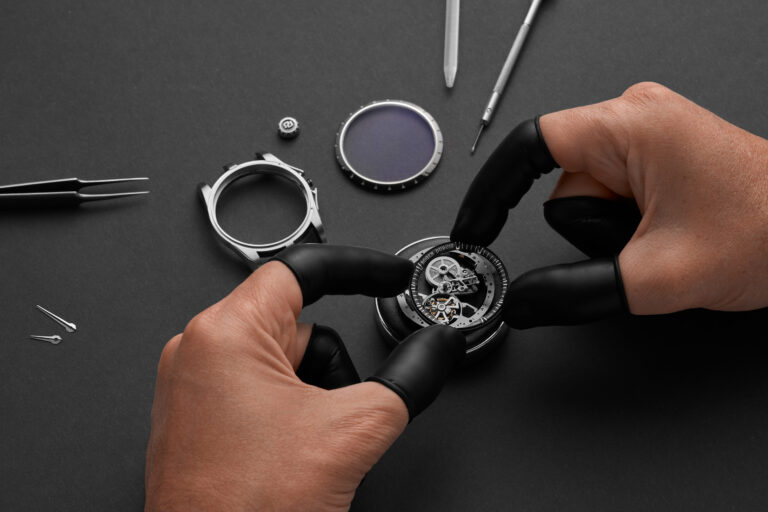
We were taken into the technical heart of the Manufacture, where watchmaking takes shape. From gear wheels to balance springs, nearly every component inside a Roger Dubuis timepiece is crafted in-house. This is truly a testament to the brand’s pursuit of near-total vertical integration, a distinct rarity even in haute horlogerie.


Our first stop was what the team fondly calls the Alibaba Place: a raw material storage room filled with shelves stacked with main plates in various calibres and materials. While you won’t find gold or platinum here, the space speaks volumes about the brand’s ongoing exploration of unconventional materials and its commitment to innovation at every level.


We were shown a range of unconventional materials Roger Dubuis has worked with over the years. One of the most notable is carbon, used to create the Excalibur Spider Carbon, the world’s first timepiece with a movement plate, bridges, and tourbillon upper cage entirely made of the material. It was also the first time a composite material earned certification from the Poinçon de Genève.


And then there’s cobalt. The brand’s so-called “love story” with this dense, high-performance metal began over a decade ago. Cobalt is notoriously difficult to work with, almost as heavy as gold and far harder to cut or machine. Yet its unique brilliance and strength make it one of the most exotic materials in the collection. Roger Dubuis has applied it sparingly but meaningfully, using it in some of their most technically ambitious calibres, from flying tourbillons to balance wheels. 


Since 2004, Roger Dubuis has embraced a skeletonised design philosophy, prioritising transparency and visual complexity over solid dials


Next, we witnessed the beginnings of complication assembly. Tiny components like escape wheels, each with 240 teeth, are hand-polished one by one, a testament to the Maison’s obsessive craftsmanship. Before moving further into assembly, every part undergoes polishing and dimensional checks, ensuring absolute precision from the very first step.


If the machining floor is where precision begins, the finishing ateliers are where personality emerges. Here, raw components are elevated into something worthy of being seen through a sapphire case back. “We continue to innovate,” Bader said, pointing to two in-house engineers focused solely on decorative techniques.


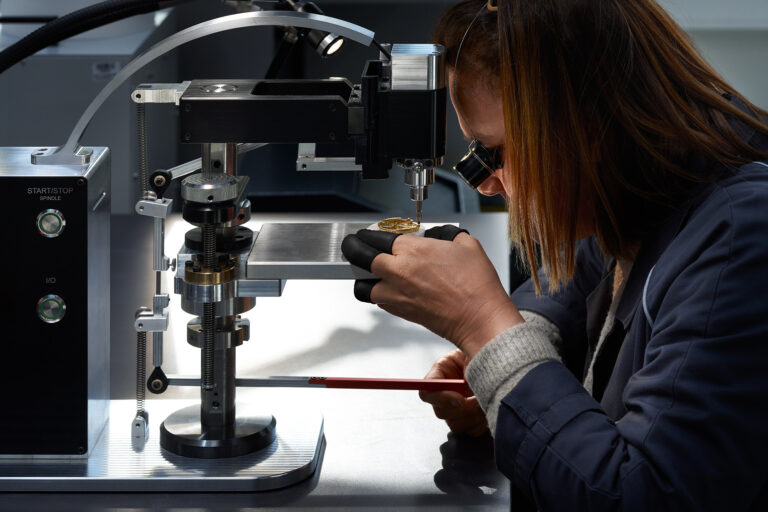
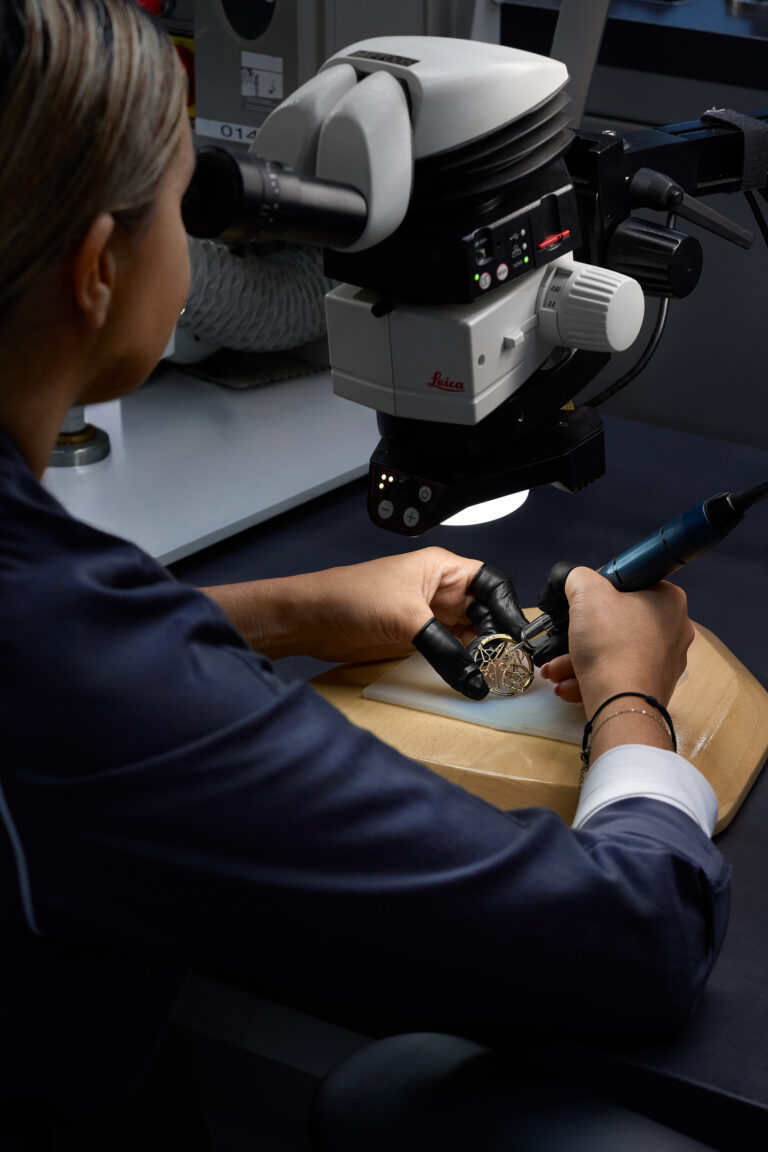
Though machines assist, it’s the artisans who bring each part to life. At one bench, Brigitte worked with a custom-built wooden wheel, relying on both skill and instinct. She could judge the wheel’s speed by sound alone. Each component, down to the smallest gear, was polished individually by hand.

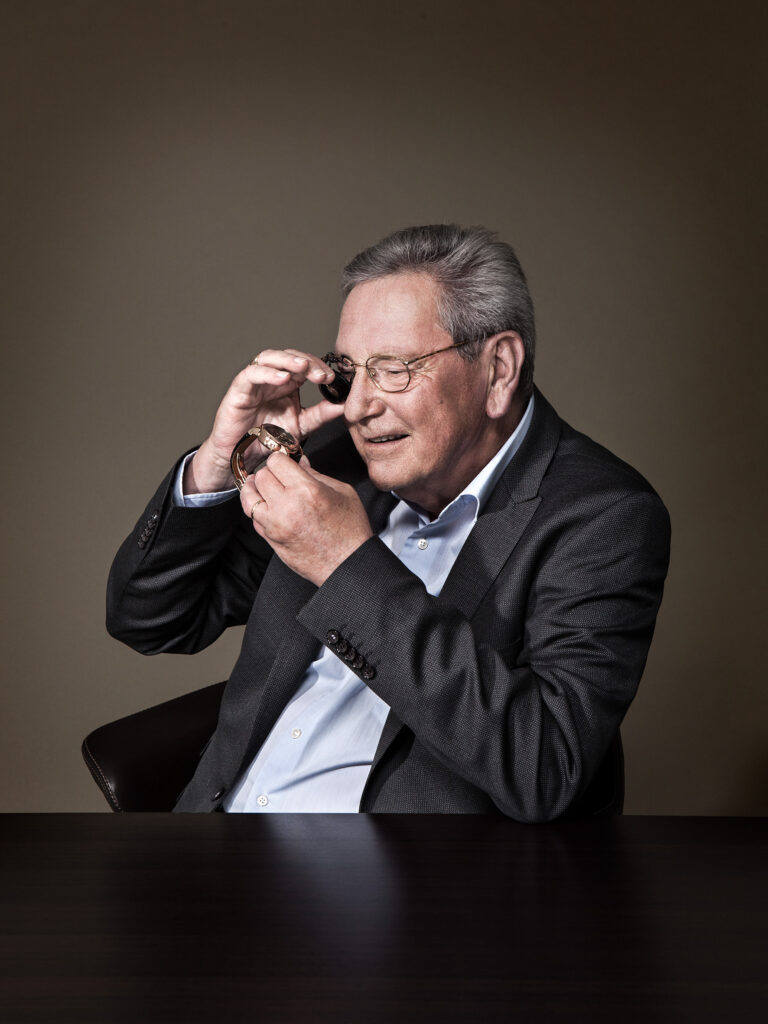
Since 2004, Roger Dubuis has embraced a skeletonised design philosophy, prioritising transparency and visual complexity over solid dials

Next, we were taken to another workbench with a screen showing the process. ​​“What you see on the screen is happening in real time,” Bader explained, as we watched a close-up of the intricate finishing process unfold. “We’re required to create a 0.9-degree angle on every component.”


This technique, known as anglage, involves hand-bevelling edges using a steel pin to meet the exacting standards of the Poinçon de Genève. At Roger Dubuis, this isn’t applied to just a select few elements; 100% of the qualifying components are meticulously bevelled by hand at specialised workstations.


As the tour progressed, we learned just how labour-intensive this process could be. A single grand complication movement could require over 74 hand-bevelled angles, with each angle taking up to 15 minutes to complete. That’s nearly 19 hours of anglage alone, not counting polishing, assembly, or testing. Some seasoned artisans can complete a single angle in under a minute, while more complex cases require careful pacing and absolute focus.


Since 2004, Roger Dubuis has embraced a skeletonised design philosophy, prioritising transparency and visual complexity over solid dials


Beside the anglage desks is a machine used for circularage, a decorative finishing technique that produces a swirl pattern often likened to a violin disc effect. The polishing serves a functional purpose as well. Without oil inside the watch, surfaces must be perfectly smooth to minimise friction, and this fine finishing allows for optimal light reflection once the components are assembled. 


We were then introduced to perlage, a decorative finishing technique that creates overlapping circular patterns across the surface of a component. Using a handheld tool, each tiny swirl is applied one at a time. In the past, this step was done using pure oak wood, chosen for its varying degrees of roughness depending on the finish desired. Different woods offer different polishing properties, lending control over brightness and texture.


Since 2004, Roger Dubuis has embraced a skeletonised design philosophy, prioritising transparency and visual complexity over solid dials


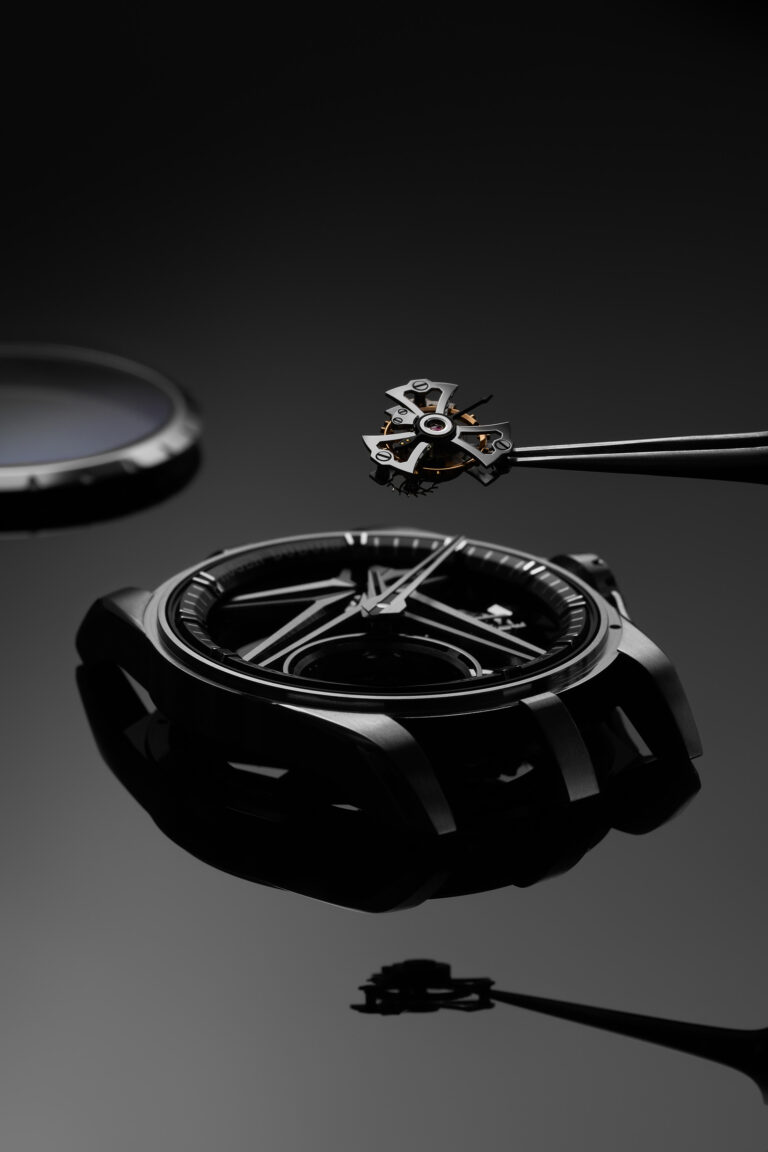
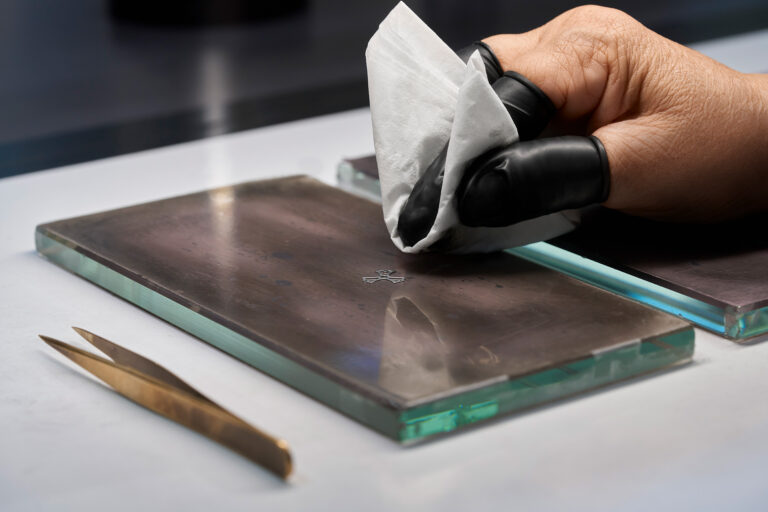
One of the most iconic examples of Roger Dubuis’ expertise soon followed: the cross-shaped cage of the tourbillon. It undergoes a meticulous finishing technique known as black polishing, an artisanal process that produces a surface that reflects like a mirror from the front and appears jet black at an angle. The polishing tool itself has been used for over 15 years, with its ultra-fine abrasive paper needing replacement only once a decade. 


Each side of the tourbillon cage is black-polished in an infinity-like motion, taking about 30 minutes per side to ensure a flawless mirror finish


We then stepped into the quality control department. Quiet, meticulous, and almost ceremonial in atmosphere, it served as the final checkpoint before any component could earn its place in a finished watch. Each part is examined by in-house “judges,” specialists who ensure that every detail aligns with the Maison’s rigorous standards. Nothing leaves this room unless it’s flawless, every time.


With each turn, we were shown not just what goes into making a Roger Dubuis watch, but how and why it’s done that way. Nothing felt rehearsed. Bader and the artisans spoke with a mix of technical confidence and genuine pride that made it clear this wasn’t just a performance for our benefit; it was a routine honed to precision. 


#ReadAnywhere

Issue #98

Your next read

The TAG Heuer x Team Ikuzawa Carrera Captures Japan’s Racing Soul

TAG Heuer, Team Ikuzawa and George Bamford reunite for a 150-piece Carrera that turns Japanese racing history into a modern collectible.

NIHI Sumba Proves Paradise Can Have a Conscience

NIHI Sumba has quietly become a rare Certified B Corporation, a milestone built on years of real work for its island and community.

Jennifer Lopez Wears Chopard Jewellery to Celebrate Her Birthday in Paris

For her 57th birthday in Paris, Jennifer Lopez leaned on Chopard for more than 500 carats of high jewellery across three unforgettable looks.

Roger Dubuis Excalibur The Kabuto Legacy Brings the Samurai to the Round Table

Roger Dubuis carries its round table from the myths of Camelot to feudal Japan with 12 hand-sculpted samurai helmets
Issue #

Roger Dubuis: A Modern Masterpiece marking 30 years of savoir-faire

Roger Dubuis celebrates 30 years of horological savoir-faire with the exquisitely layered Hommage La Placide
Issue #

Roger Dubuis: An Excalibur Evening in Jakarta

Roger Dubuis hosts VIP dinner at JinJoo, spotlighting the Excalibur Biretrograde Calendar
Summary

Roger Dubuis: Where The Magic Happens in Motion

  • [please provide the article's summary here]