Founded in 1995 by master watchmaker Roger Dubuis, the Geneva Maison has always stood at the crossroads of expressive design and uncompromising horology. From the very beginning, Roger Dubuis championed fully in-house calibres, traditional finishing elevated to contemporary extremes, and an unwavering commitment to the Poinçon de Genève. To mark its 30th anniversary, the Maison revives the Hommage La Placide, a limited edition of just 28 pieces conceived as both a tribute and a modern revival.
Tracing back its history, the background of this release is deeply personal. The original Hommage collection, launched in 1996, honoured the mentors and watchmakers who shaped Roger Dubuis’ career. Three decades on, the Hommage La Placide reverses that lens, celebrating the watchmaker himself. Its name references “Placide,” Roger Dubuis’ childhood scout nickname, a reflection of his calm, thoughtful character—an ethos subtly woven into the watch’s restrained elegance and layered complexity.
At the heart of this anniversary piece lies a rare mechanical dialogue between past and present. The journey begins with the RD14, the Maison’s first in-house automatic calibre. Originally introduced in the early 2000s, each surviving RD14 movement has been meticulously restored, recalculated, and re-engineered. Its traditional swan neck regulator—valued for precision adjustment and shock resistance—returns alongside original Roger Dubuis balance springs, a historic element that once secured the brand’s status as an official manufacture. Subtle yet significant updates, including a complete repositioning of the gear-train axes, enhance performance without erasing its historical soul.
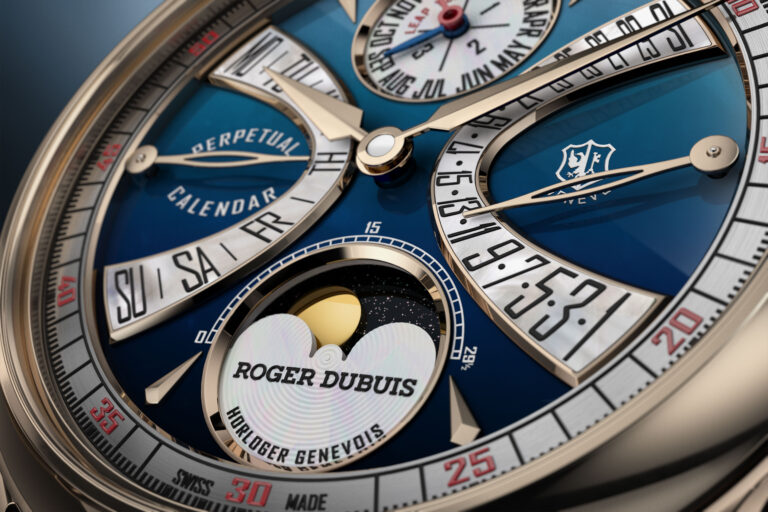
Layered onto this foundation is the RD72 module, first introduced in 1999 and chosen here for its symbolic weight. A perpetual calendar was Roger Dubuis’ favourite complication, and the RD72 delivers it with elegance: day, date, month, leap year, and moonphase displayed through a signature biretrograde mechanism. Ingeniously, month and leap year are read on a single counter via two co-axial hands driven by star wheels with 12 and 48 teeth, ensuring smooth, intuitive transitions across the calendar cycle.
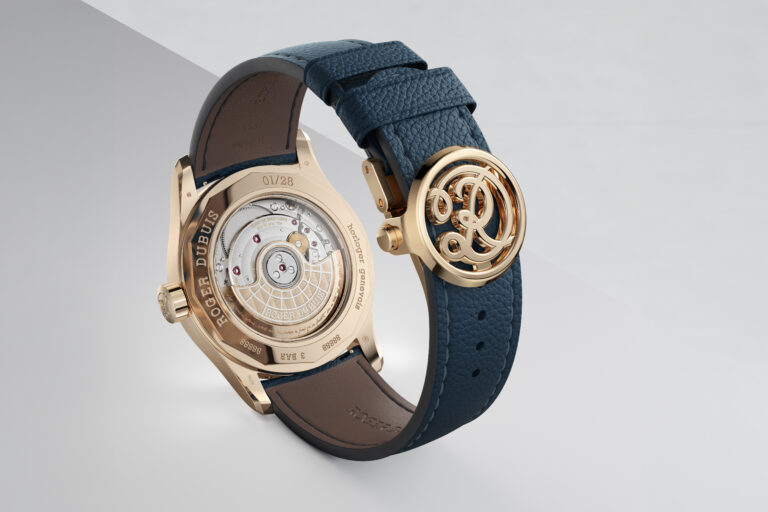
The union of these two movements forms the RD1472 calibre—a modern revival produced for only the second time. Automatic and self-winding, it beats at 4 Hz (28,800 vibrations per hour), delivers a 48-hour power reserve, and comprises 307 components and 33 jewels. A newly crafted 18-carat pink gold rotor crowns the movement, which is finished with no fewer than 15 decorative techniques, from Geneva stripes to mirror polishing and hand-drawn bevelling. Most importantly, the calibre is adjusted and assembled to meet today’s stringent Poinçon de Genève standards, now applied to the entire watch rather than the movement alone.
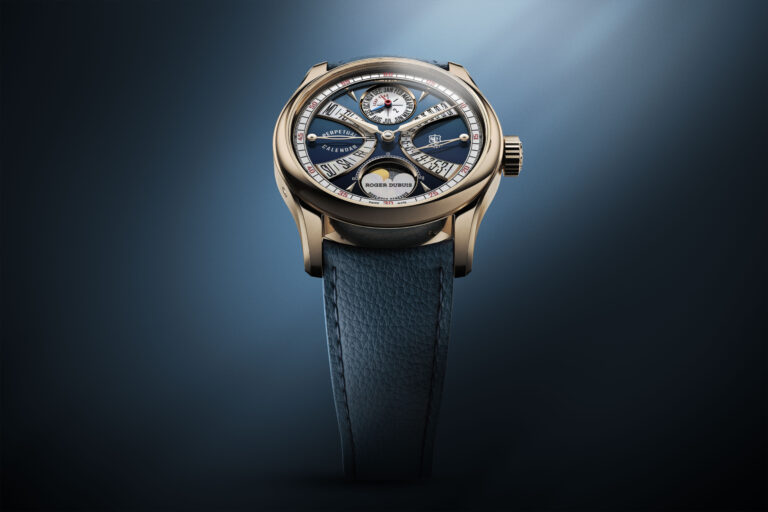
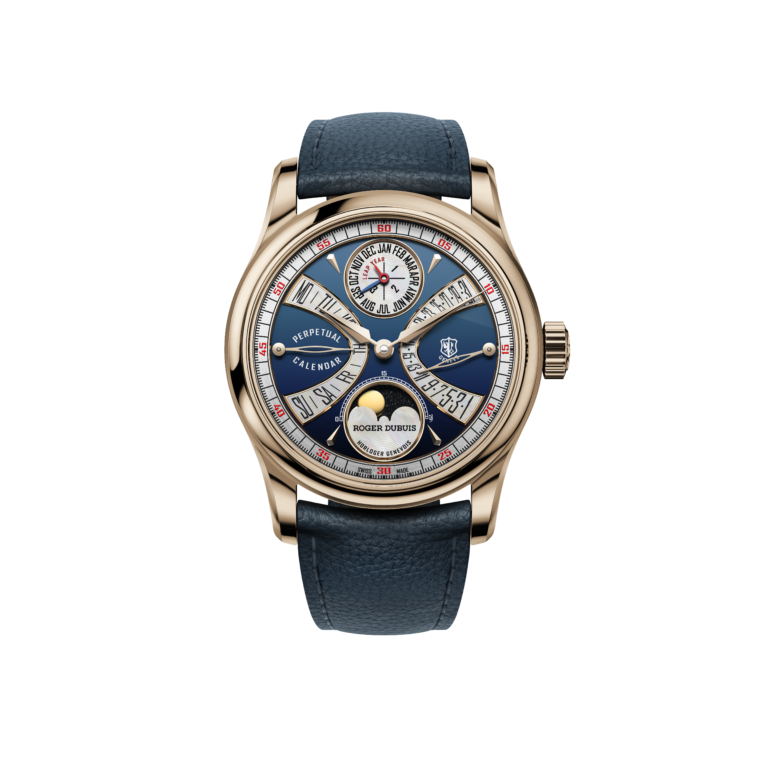
The dial is visual poetry. Constructed in five distinct layers, it exemplifies Roger Dubuis’ talent for expressive architecture. A rhodium-coated, circular-brushed flange frames the display, while mother-of-pearl calendar segments add softness and depth. The main plate appears in “Leman Blue,” a lacquered hue inspired by Lake Geneva, punctuated by applied hour markers and lunar inscriptions. Mother-of-pearl counters and a moonphase set against blue aventurine, adorned with domed 18-carat yellow gold moons, complete the composition—each layer revealing another facet of complexity.
Encased in a 38 mm 18-carat pink gold case, the Hommage La Placide balances classical proportions with modern presence. It is water-resistant to 30 metres and is paired with a blue interchangeable calf leather strap that is secured to the wrist by a pink gold triple-folding buckle engraved with the Roger Dubuis emblem. Each timepiece is presented in a dedicated collector box, complete with a push corrector, magnifier, as well as certificates of authenticity and Poinçon de Genève.
More than just a commemorative object, the Hommage La Placide is a quiet manifesto: a reminder of Roger Dubuis’ vision and work as a master watchmaker who dedicated his life to the art of timekeeping.