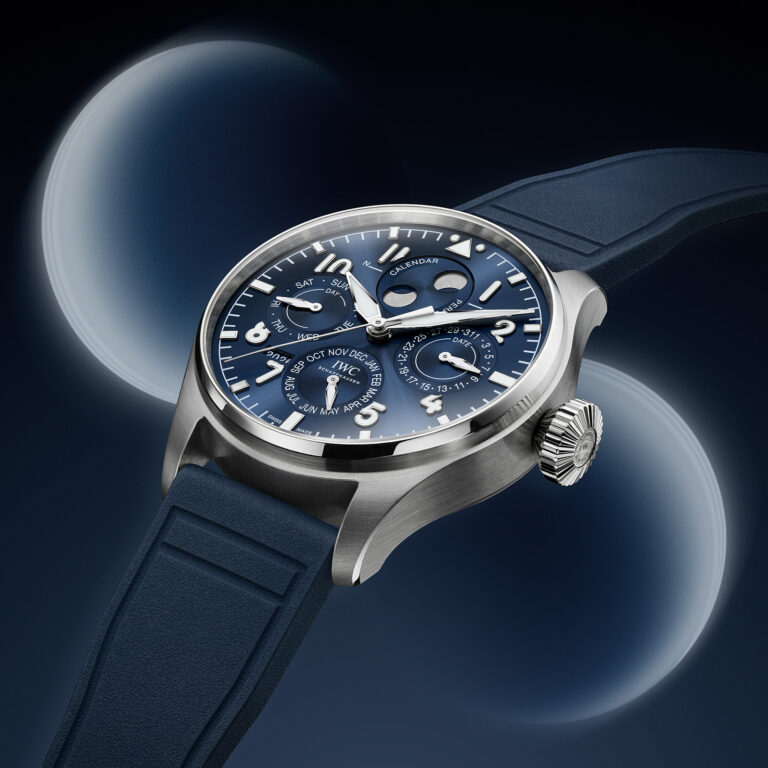
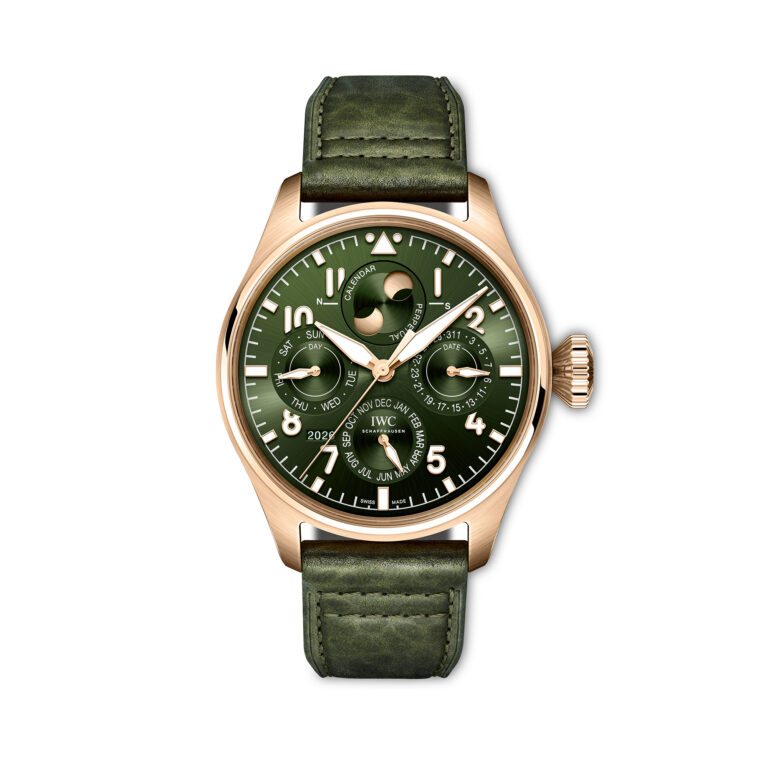
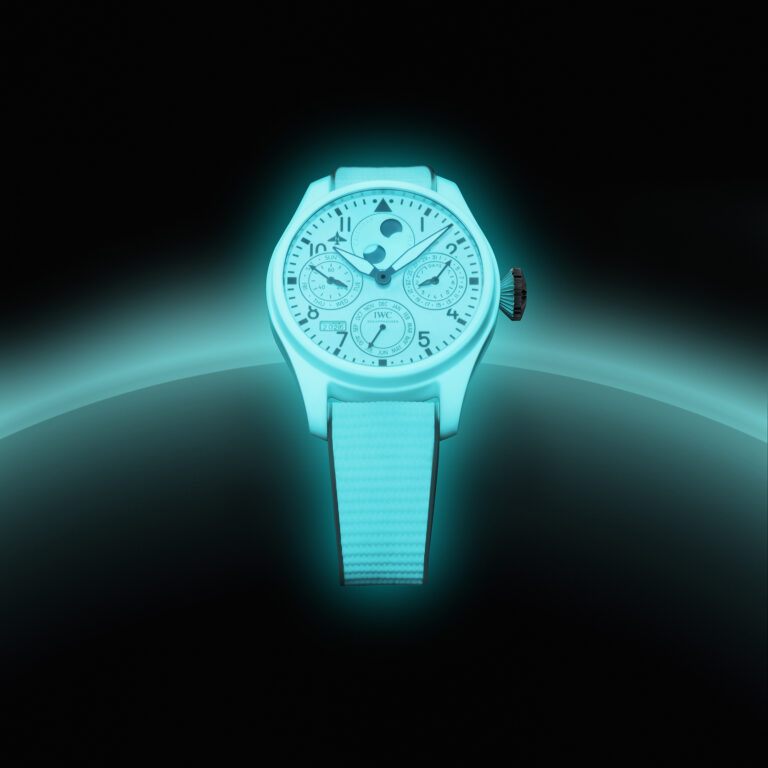
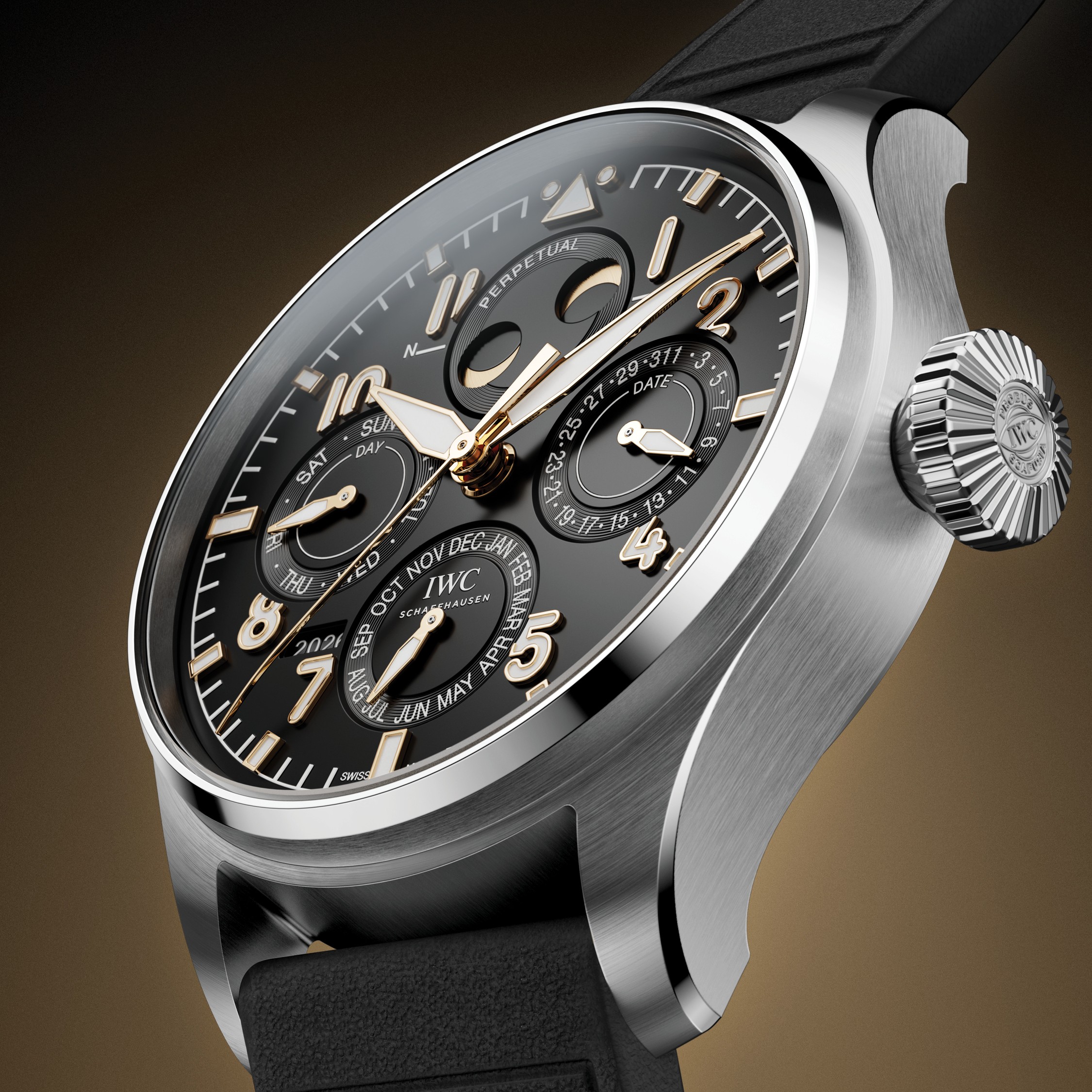
Beneath this striking exterior lies the calibre 52616, a high-end automatic movement operating at 4 Hz with an impressive seven-day (168-hour) power reserve. The movement incorporates a Pellaton winding system with ceramic components for enhanced durability, as well as a perpetual calendar displaying date, day, month, four-digit year, and IWC’s Double Moon® phase indicator, which deviates by just one day even after five centuries. The watch transforms seamlessly from day to night. By day, the watch presents a monochromatic interplay of matt and polished surfaces; by night, it changes form and transforms into a fully luminous instrument.
IWC also launches a new model that combines titanium with the crown-controlled perpetual calendar from Kurt Klaus. The Ingenieur Perpetual Calendar 41 (IW344904) combines the Gérald Genta-derived integrated bracelet design with an execution in titanium for the first time. It features a grade 5 titanium case measuring 41 millimetres in diameter and an integrated titanium bracelet. The bracelet is attached to the case via its middle links, offering excellent ergonomics. As titanium is about 45 percent lighter than steel, the watch feels very comfortable on the wrist.
Inside the titanium case, the IWC-manufactured 82600 calibre is at work. This high-end automatic movement features a Pellaton winding system, which uses movements of the oscillating mass in both directions to wind the watch. Equipped with a 60-hour power reserve, the movement drives the perpetual calendar, which will recognise the different lengths of the months, including leap years. Developed in the early 1980s by IWC’s former head watchmaker, Kurt Klaus, the perpetual calendar is mechanically programmed to account for many of the Gregorian calendar’s irregularities.
Together, these novelties signal a clear direction for IWC Schaffhausen. Rather than treating complications as static achievements, the manufacture approaches them as evolving systems, ones that must adapt to modern expectations of usability, resilience, and design. In doing so, IWC not only advances the perpetual calendar as a mechanical feat, but redefines it as a dynamic, intuitive companion for contemporary life.