
Roger Dubuis has built its whole personality around a sword. Excalibur, one of the brand’s iconic collections, takes its name from the blade of King Arthur. And the maison has always worn that legend with a certain swagger by pairing bold and skeletal mechanical prowess with a taste for myth. It is further emphasised by the newest release, the Roger Dubuis Excalibur The Kabuto Legacy, the most daring twist yet on an idea the collection has spent more than a decade perfecting.
That idea took shape in 2013, when the Excalibur collection welcomed its first Knights of the Round Table. Rather than a conventional dial, Roger Dubuis stood 12 hand-engraved knights in a circle around a central table, turning the Arthurian tale into a tiny sculpted scene you could wear. It was Métiers d’Art at its most theatrical, and it soon became one of the collection’s calling cards.
The concept kept evolving from there. A second edition arrived in 2015 and a third in 2021, each refining the knights and their table, while the related Excalibur Table Ronde folded in glowing grand feu enamel. Only last year did the collection even include Merlin the enchanter among the figures. Through every version, one thing held firm. It is the ring of 12 characters circling the dial.
For 2026, the Excalibur collection has gone bolder still. It has picked up that round table and carried it thousands of miles east, trading the myths of Camelot for the very real history of feudal Japan. In place of knights, 12 samurai now hold the circle. Here is what makes this latest chapter one of the most fascinating watches of the year.
The Samurai Story
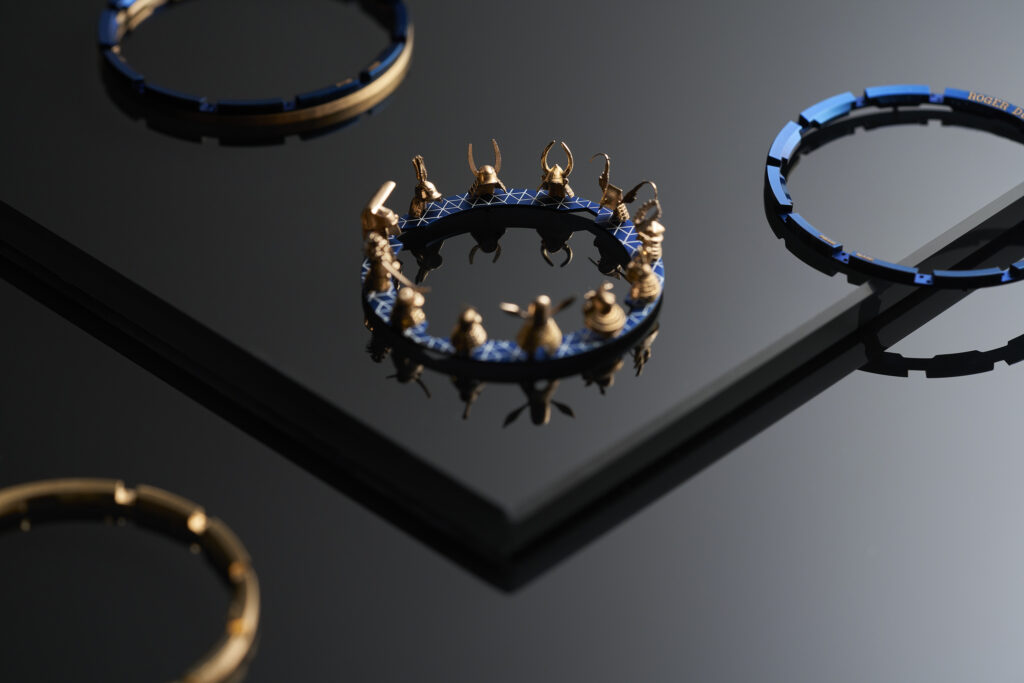
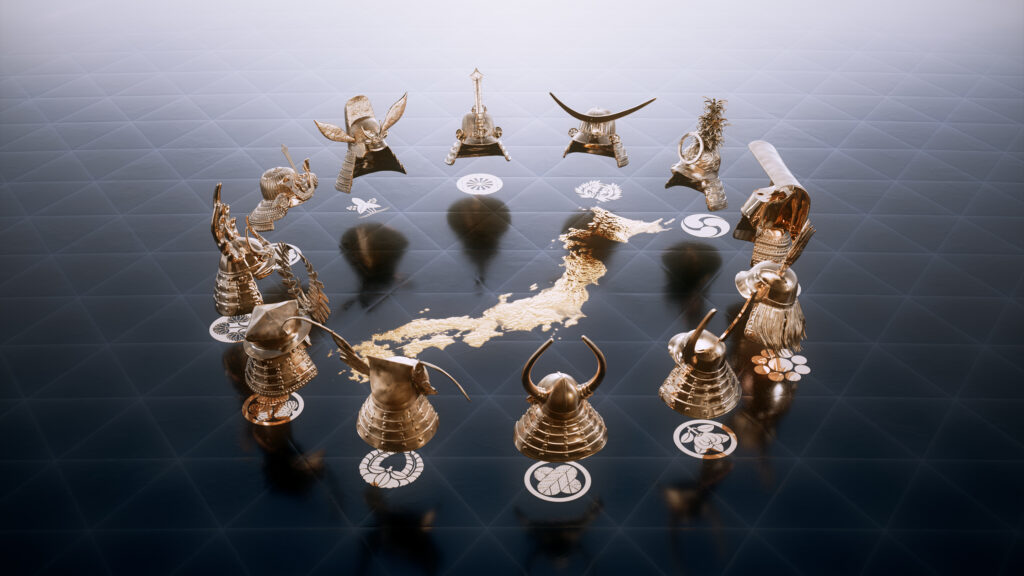
The story reaches back to 17th-century Japan, a land torn apart by warring lords until a few leaders finally united it and ushered in more than two centuries of peace. Roger Dubuis distils that rare moment of harmony into 12 helmets—or kabuto—each standing for a real commander who shaped the era.
At 12 o’clock sits the shogun himself, Tokugawa Ieyasu, his helmet crowned with a fern for longevity and success. Around him gather his legendary guardians, remembered in Japan as the Four Heavenly Kings. Honda Tadakatsu wears his famous sweep of deer antlers, while Sakai Tadatsugu, Sakakibara Yasumasa and Ii Naomasa each carry crests that speak of loyalty and the will to cut through deception. Seven more warriors complete the circle.
In their day, a kabuto was never mere armour. It announced a warrior’s rank and ambition at a single glance, which makes it a natural stand-in for the knights this collection usually seats around the table.
The Handcrafted Details
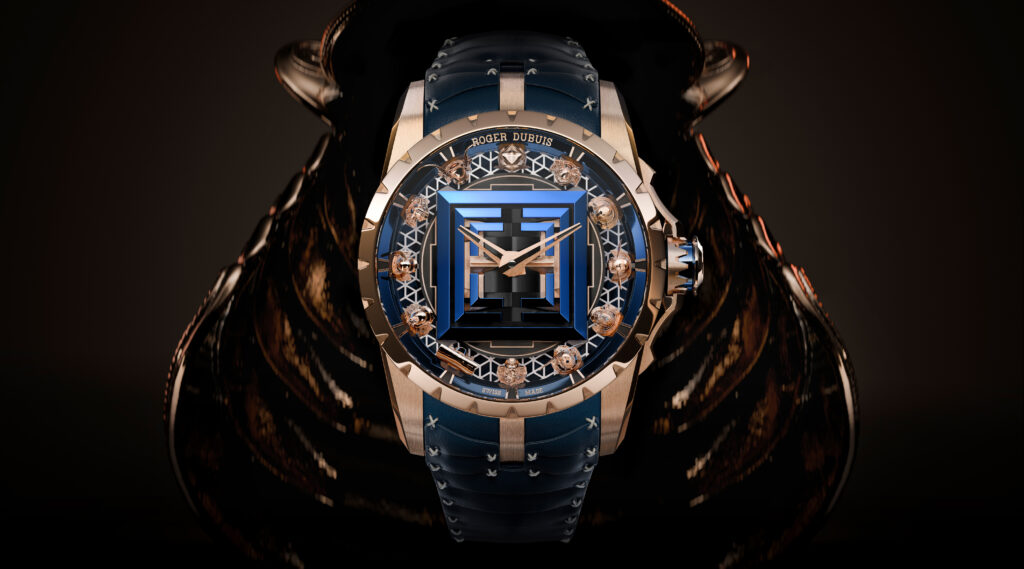
Look past the history, and the handwork becomes almost hard to believe. Each of the 12 kabuto is micro-sculpted in 18-karat pink gold, then finished by hand under a loupe. A single helmet can take two to three days to complete, and the fiddliest part is always the small crest at the front, the kamon that once identified each warrior on the battlefield. Those tiny emblems are what separate one commander from the next, so they earn the most obsessive attention of all.
At the centre of the dial rises an abstract vision of Edo Castle, and it is a feat of construction in its own right. Seventeen individual pink-gold elements are stacked into a layered fortress. Seven of its roof pieces glow with a blue CVD coating, while six more are darkened with black PVD for contrast. Three structural elements are left in bare pink gold, and the base is finished with laser-engraved decoration that adds another layer of depth.
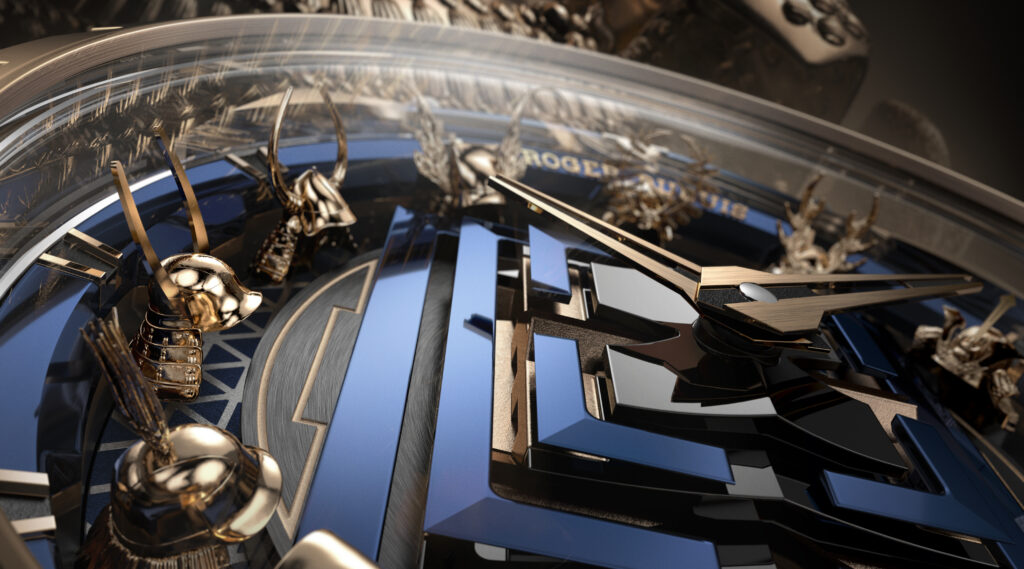
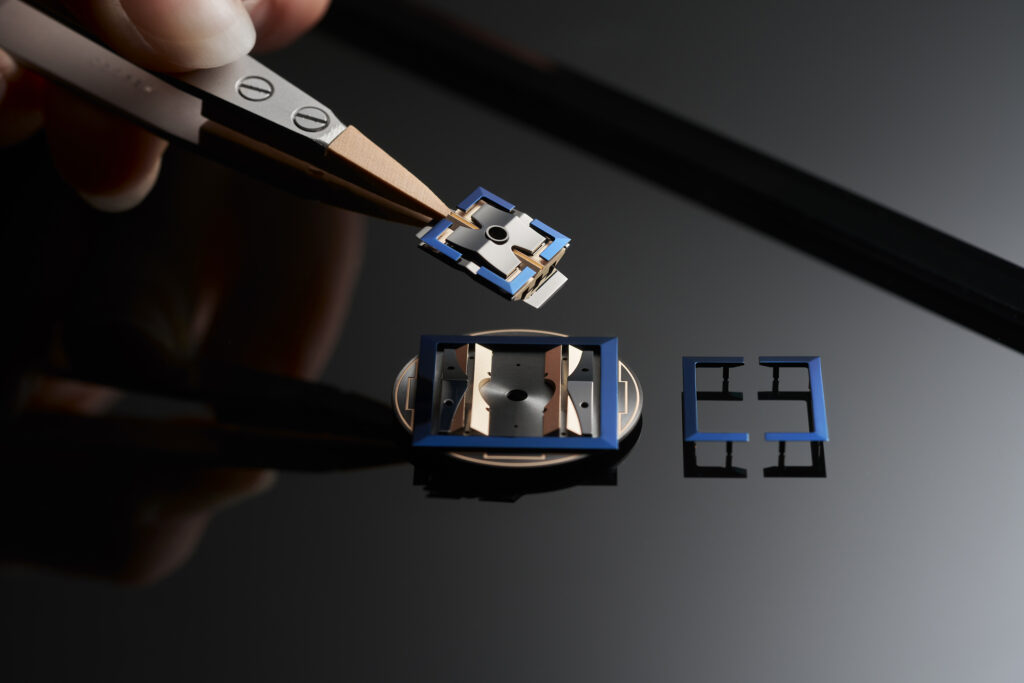
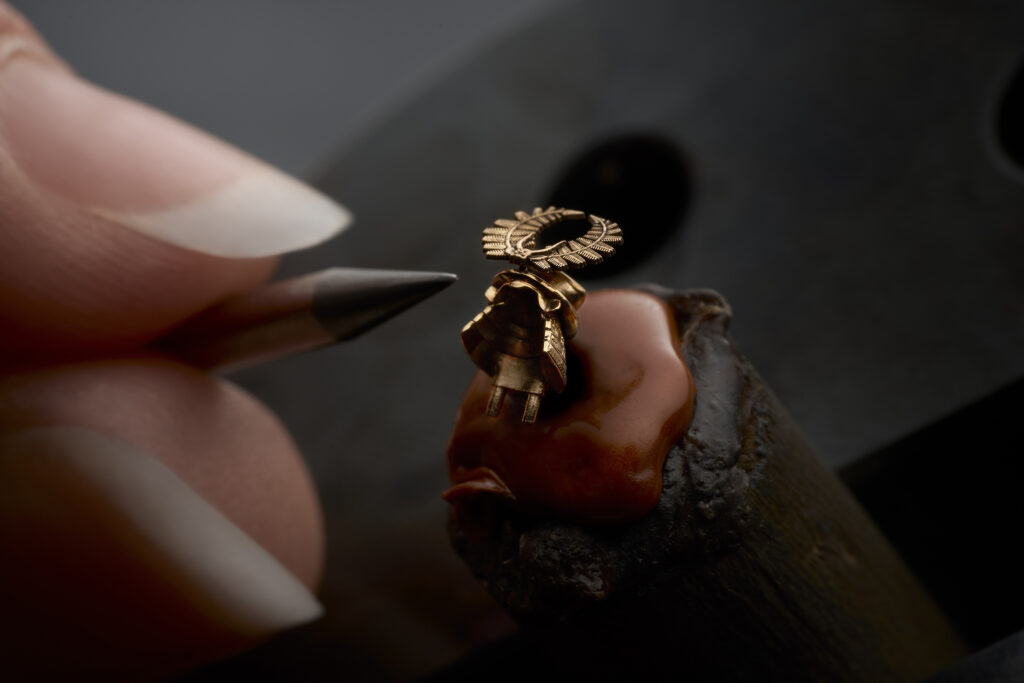
That blue is anything but a random choice. It echoes indigo, the dye the Japanese long used for samurai garments and later for their art, a shade so bound up with the country that it earned the name Japan Blue. To make the fortress catch the light, the artisans work four separate finishing techniques across its facets. Some surfaces are mirror-polished to a bright shine. Others take a fine circular grain or a soft shot-blasted texture, so the castle never once looks flat.
The case that frames all this is carved from the same pink gold and measures a generous 45 mm across. It wears the fluted bezel that marks out every Excalibur, with a sapphire ring set beneath it to frame the scene. At 16.87 mm thick, it is a substantial watch, though that height is precisely what makes room for the sculpture inside. Even the crown is dressed for the occasion, ringed with blue enamel and set with a small glass window.
For all the drama, the watch tells the time in the simplest way it can. There are only hours and minutes here, read off two satin-brushed pink-gold hands, so nothing competes with the artwork beneath them. The strap keeps the theme going as well, its blue calfskin cut and stitched into overlapping tiles that mimic the laced plates of samurai armour, complete with a worn, battle-ready patina. It clips off in seconds on a quick-release system; a second strap waits in the box, and a pink-gold triple-folding buckle holds everything in place.
The Movement Within
Flip the watch over, and the substance matches the spectacle. Beating away inside is the RD821, an automatic movement built entirely in-house. What really sets it apart is the finishing, with 14 separate techniques applied to the surfaces of every single component. Matte and polished areas are played off against one another so the light dances across the mechanism the way fine Geneva watchmaking demands.
The numbers hold up to the artistry. The calibre is ticking at 28,800 vibrations an hour. A full wind of the watch stores 48 hours of running time. Cleverly, the movement stays slim at just 3.5 mm thick, which is exactly why the castle and its helmets had somewhere to sit above it.
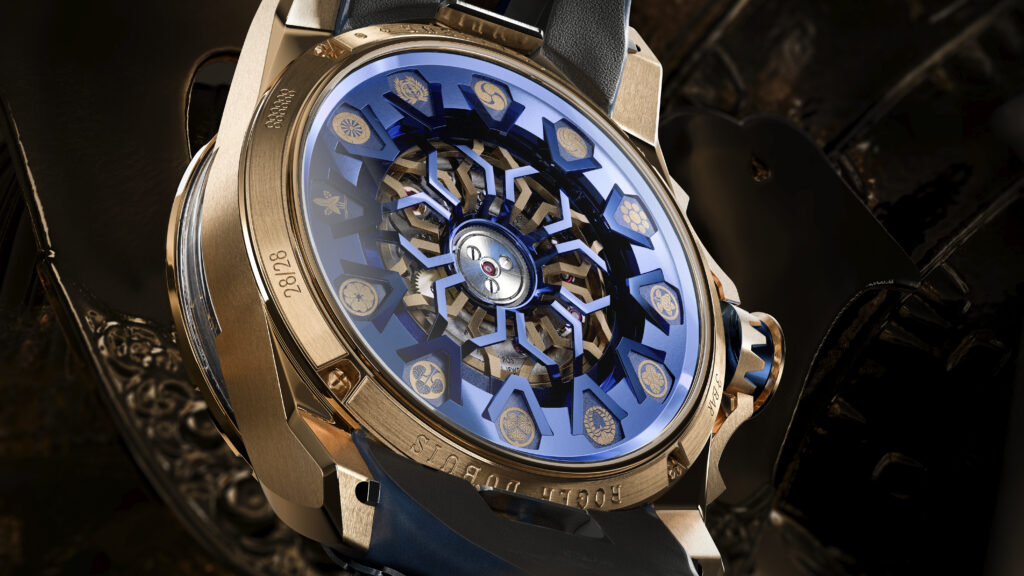
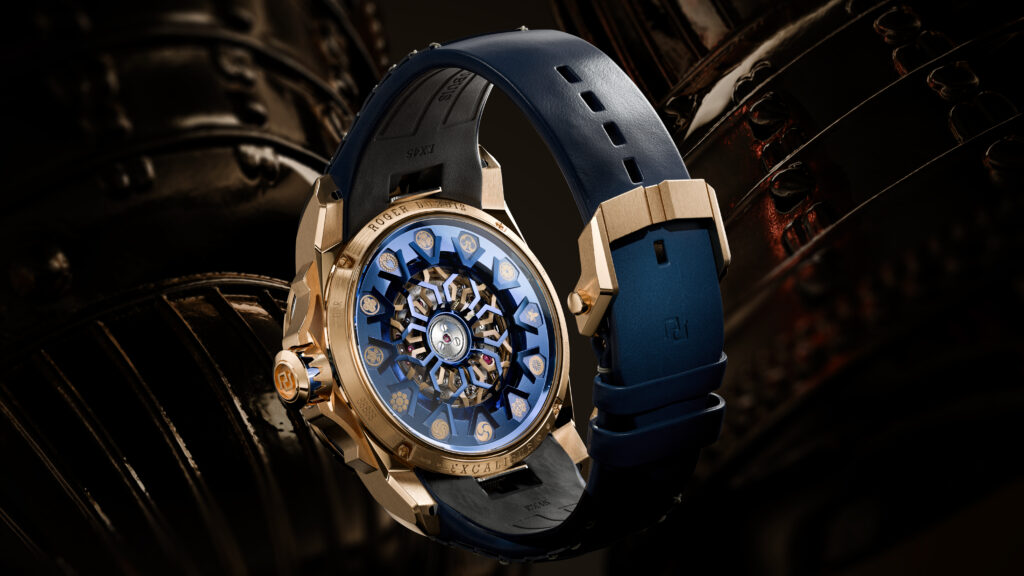
Then comes the stamp that matters most. The RD821 carries the Poinçon de Genève, the Geneva Seal, one of the oldest and strictest quality marks in all of watchmaking. It requires a movement to be crafted and finished to exacting standards within the canton of Geneva. Roger Dubuis is famous for holding this certification across its entire collection, something almost no other maison can claim, so the seal reads like a signature.
Best of all, none of the work is hidden away. The caseback is left open, and a pane of sapphire reveals the elaborately worked rotor turning as you move. The tribute to Japan continues even here, with a blue-coated pink-gold ring circling the movement, laser-engraved with the twelve samurai crests so the story wraps right around the watch.
Only 28 collectors will get to own one, and that feels about right. This is a watch that folds a whole chapter of Japanese history onto the wrist, then backs the drama with the kind of watchmaking Geneva saves for its very best.