
How does a Paris salon, with its mirrors and silence, translate to a beach where the main occupation is luxuriating and idling under the sun?
Matthieu Blazy answers this in the CHANEL Cruise presentation Sous le salon la plage: underneath the salon, the beach. The phrase, once a provocation, now feels like a quiet manifesto for summer dressing. A reminder that beneath the structures of the everyday lies the possibility of escape.
Biarritz became the testing ground. In 1915, Gabrielle Chanel took the Villa de Larralde near the casino, where she set up a boutique, ateliers, and an apartment under one roof, a model she would later rebuild at 31 Rue Cambon, the maison’s most storied Parisian address. Distance from Parisian etiquette was the prerequisite, as what she did next would never have passed there.
It was in Biarritz that she cut capes and dresses from jersey, a knit once confined to underwear, and the pieces were sold out before the Parisian couture establishment could voice its disapproval. The town later drew other artists in search of the same air. Stravinsky and Cocteau arrived, and Picasso painted The Bathers there in 1918.
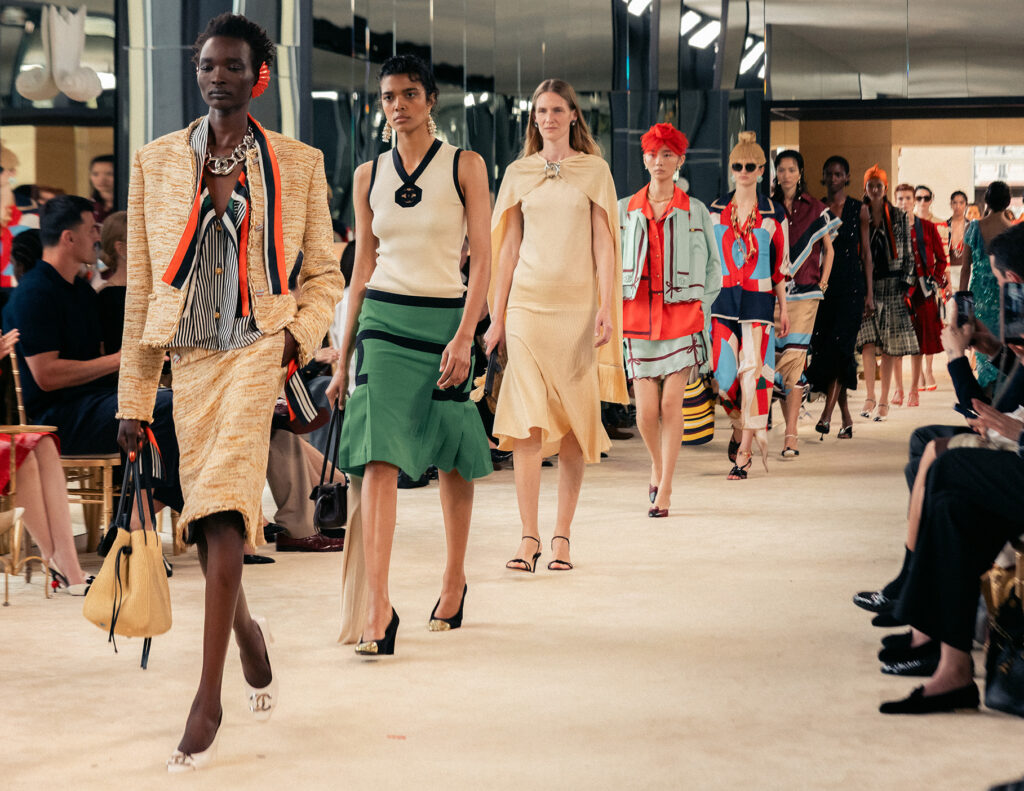
That inheritance draws Blazy back for Cruise 2026/27, the first he has staged for the maison. He set the collection’s 79 looks in a glass‑sided salon above the Atlantic, on a carpet the colour of wet sand, from which the models cascaded down the stairs before parading around the esteemed guests of the maison.
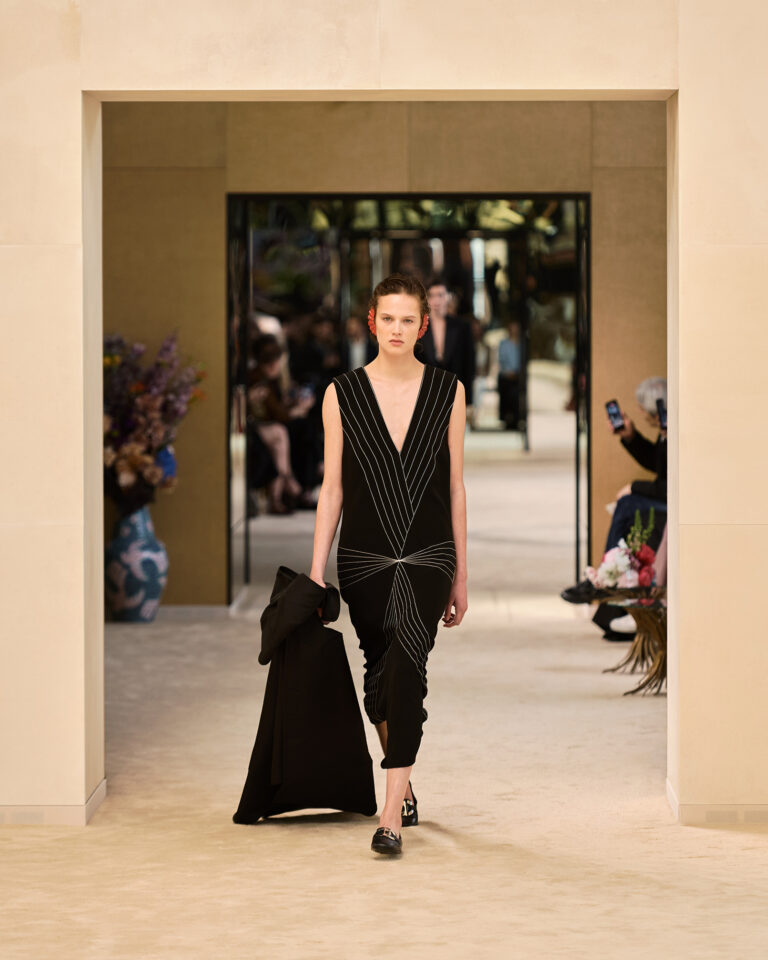
He begins where the archive is densest: the Little Black Dress. Look one is a drop-waist midi in black crepe, cut to a deep V and stitched in white lines, derived from the 1926 dress Vogue dubbed CHANEL’s Ford (after the car that came only in black).
The sketch shows only the front, so nobody ever saw the bow tied at the back. Blazy lifts it off and makes it a clutch with its ribbons trailing to the floor. “Much is said about the ‘revenge dress’,” he writes in the show notes. “This might be considered the original one.” The dress keeps returning, in tweed, in fringed leather, as a quilted coat, as a ground for embroidery, until black works as the spine of the show.
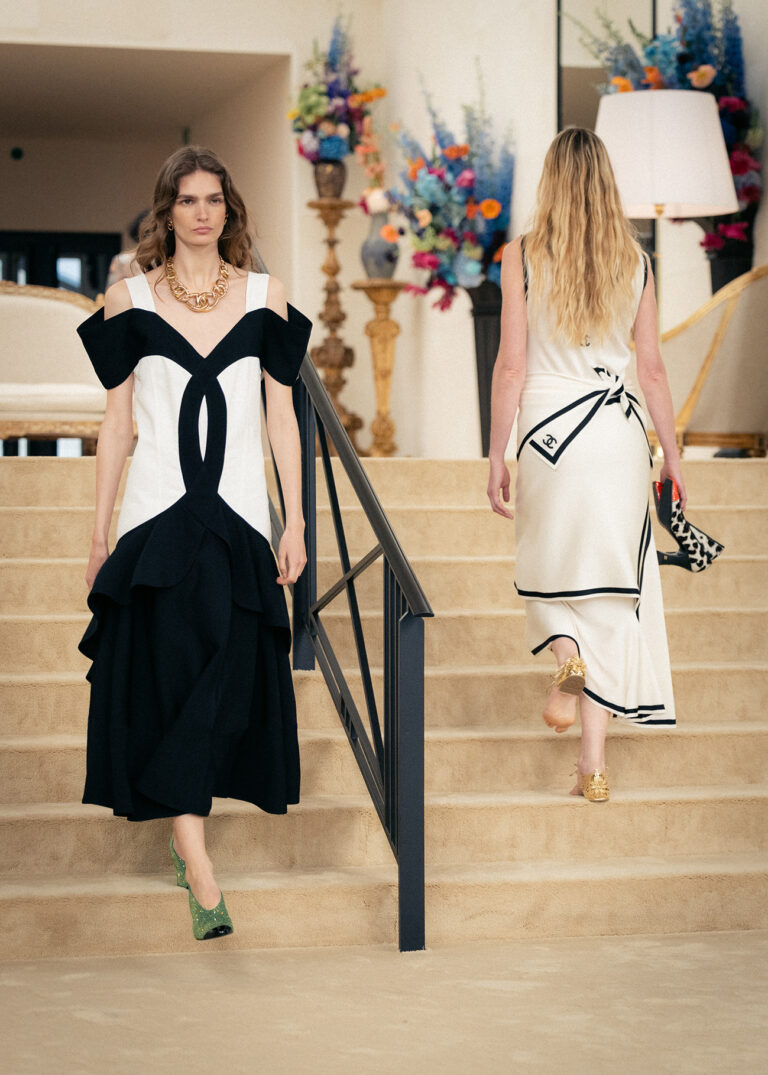
Then the show loosens its grip and the sea supplies the references. What follows is resortwear with its polish intact.
Colour arrives as it does on that coast, as seen on the Basque stripe in red, navy, and ecru that runs through the knits and canvas suiting. Dresses built on the logic of a bathing suit, caftan-like shirt dresses hanging loose, cardigans tied at the waist, beaded and monogrammed bathing caps clamped over the ears like an aquamusical. The interlocking C works as construction instead of branding, framing a white neckline and an off-shoulder bodice like Art Deco masonry. Then the embellishment arrives with the sea behind it.
A laser‑cut coral dress appears early in the sequence—its form echoing coral itself—while the two closing looks shimmer like mermaids, paillettes overlapping into scales in furnace orange and aquamarine hues.
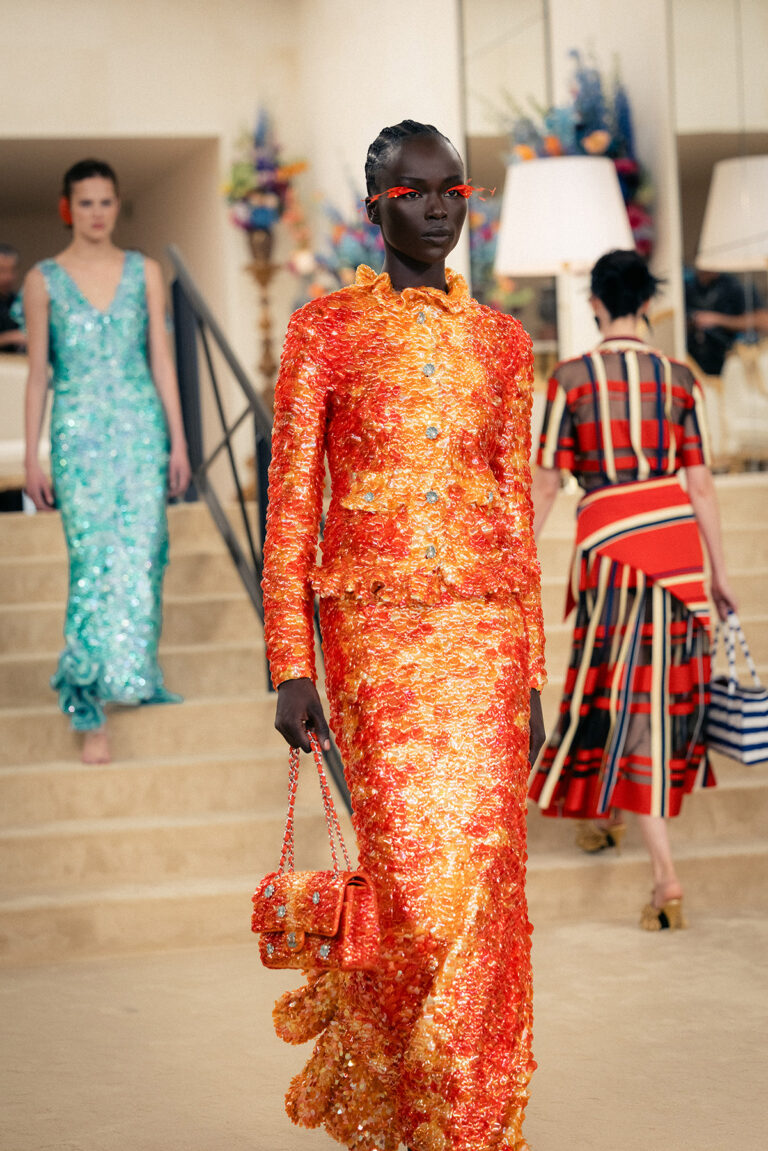
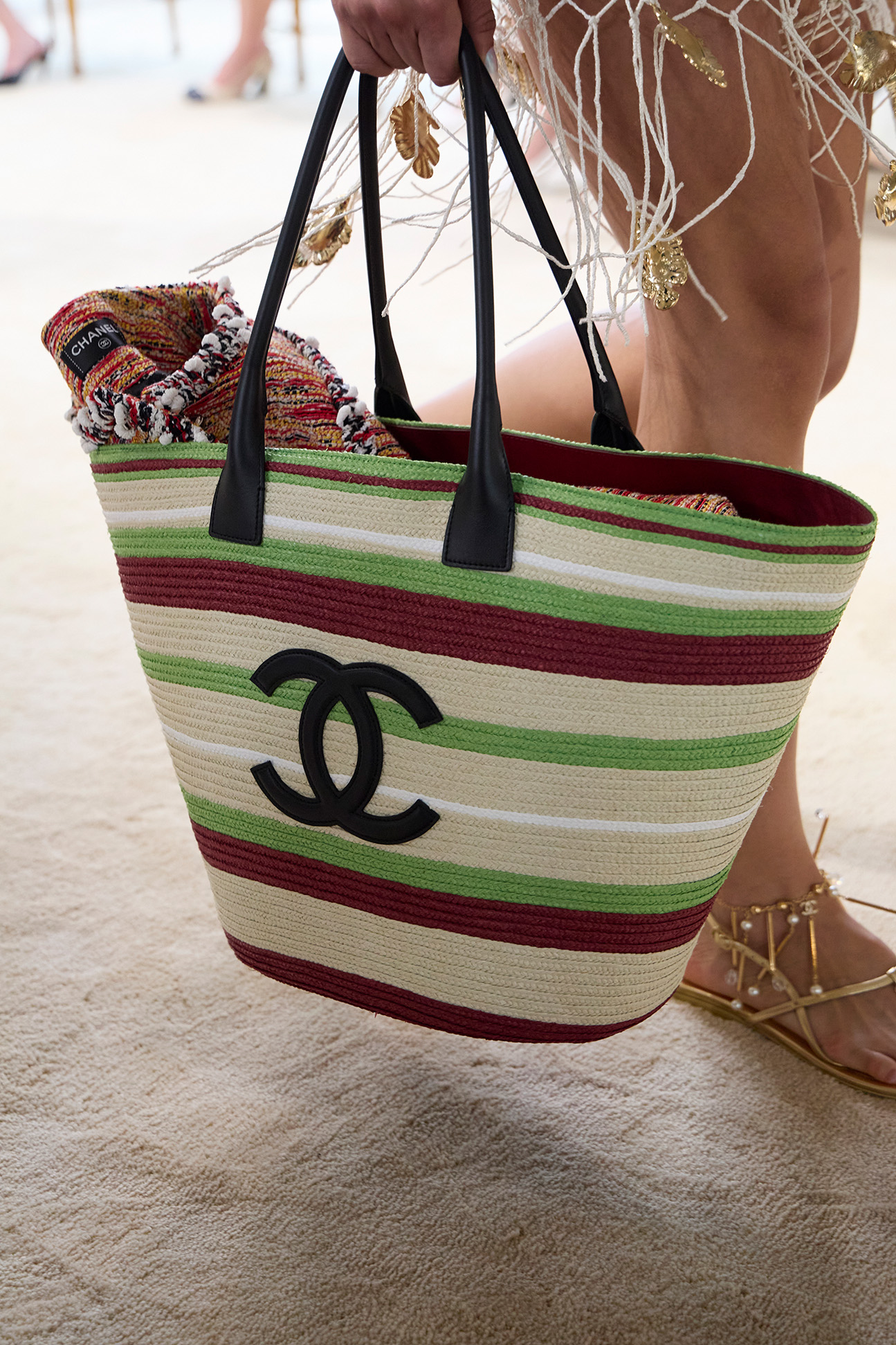
The bags are packed for a journey, not a photograph. A flap bag becomes waterproof, and the stripe returns on a beach panier at picnic-hamper scale. Shoes trace the same passage, animal‑print pumps carried at one end, a heel cap worn on a bare foot at the other. Zooming in on the accessories, shells and gilded seahorses swing from the ears, with the CHANEL pearl nestled among them, embodying the house’s DNA at its purest.
In Biarritz, Gabrielle Chanel proved that fashion could be liberation. A century later, Blazy has returned with CHANEL to the same Atlantic edge, the maison’s inheritance renewed in his hands, the horizon unchanged yet reclaimed anew.