Could you share the story behind your name?
My father loved reading history books, and that inspired him to give me a classic name. He once said that Henryette Louise reminded him of a woman soldier who led a war. Later, there was a time when I asked him to change my name to “Louise Sutinah” because I felt it was closer to my Javanese background. I also liked that it had an “a” vowel (in Sutinah), since in Javanese culture, names with an “a” sound are often associated with a friendly person.
What are the main influences behind your surrealist work?
The invisible spirit! I grew up with my grandparents. My grandmother sold rampek, collections of things used for rituals or offerings. I spent most of my days with her, which gave me the chance to encounter many people who needed rampek for different reasons, from those who needed it to protect or care for something to those preparing for a funeral. I think these experiences are what led me to the surrealist imagination that I still carry with me today.
What meaning does black hold in your artistic practice?
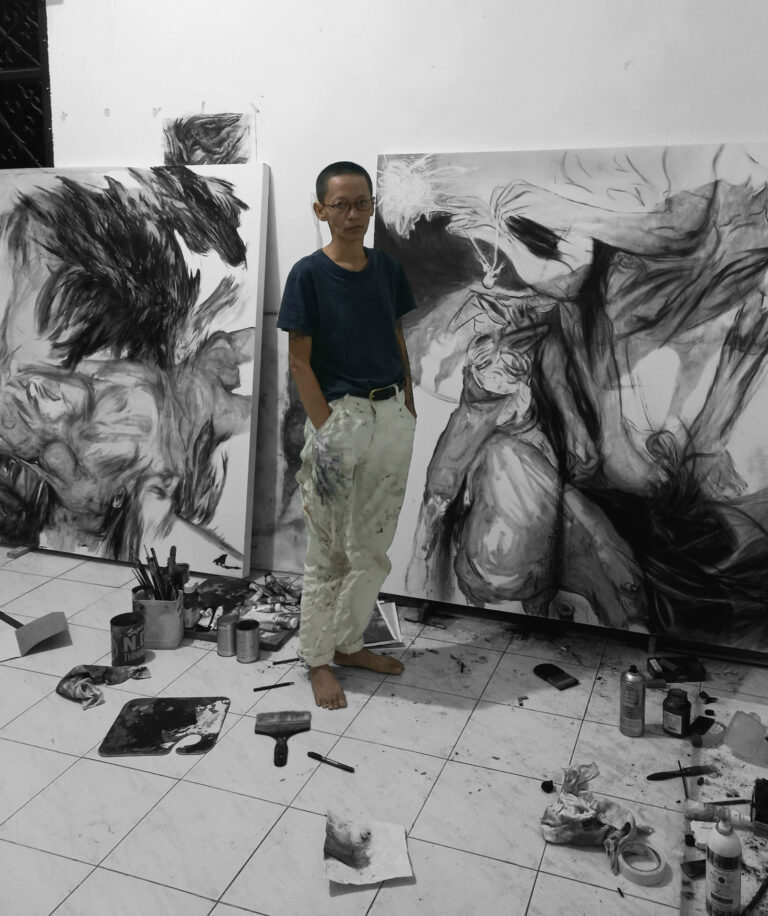
Technically, from what I learned in art school, I think black is the colour closest to charcoal and the ink I use for printmaking. Theoretically, it must also be related to shadows, contrast, and mass. But beyond those reasons, black reveals depth and a transformative state within the process of making, something I cannot deny. It reveals so much of the unseen, the unknown, and the hidden!
What techniques do you explore, and how do they express your imagination?
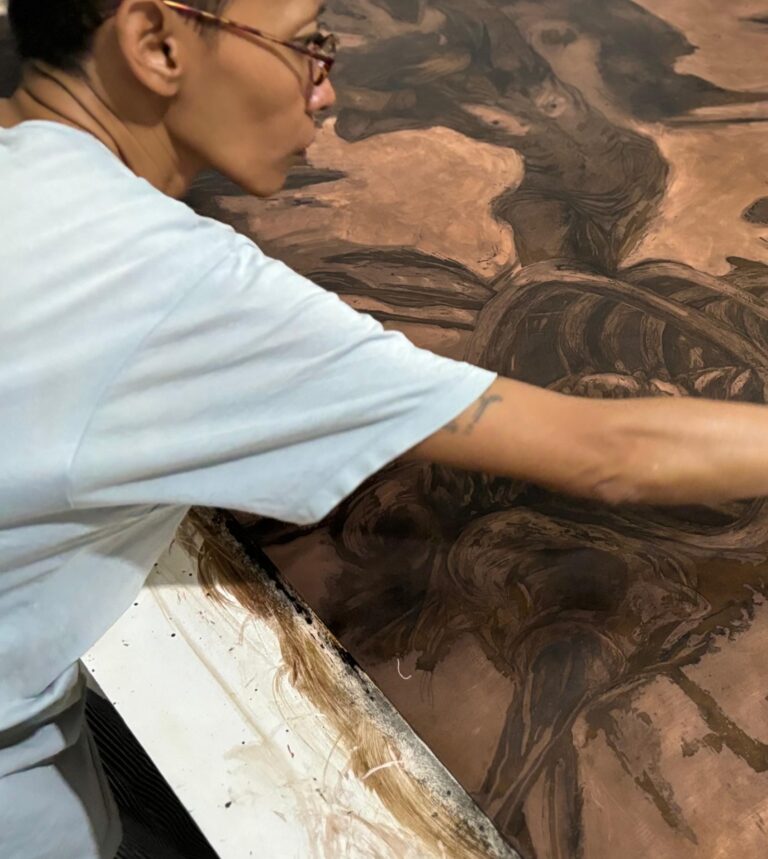
I’ve always moved from one technique to another, from drawing and painting to printmaking, sculpture, kinetic art, and sound. But over the past few years, I’ve been exploring an expanded printmaking technique: intaglio. I work on a copper plate and then transfer the print onto a gypsum body. It might not offer me a faster or easier way of working, but it gives me a sense of attunement, another way of making time for imagination. I think imagination comes from the gesture of attunement, as a counterpoint to the speed that has become so deeply embedded in our civilisation today.
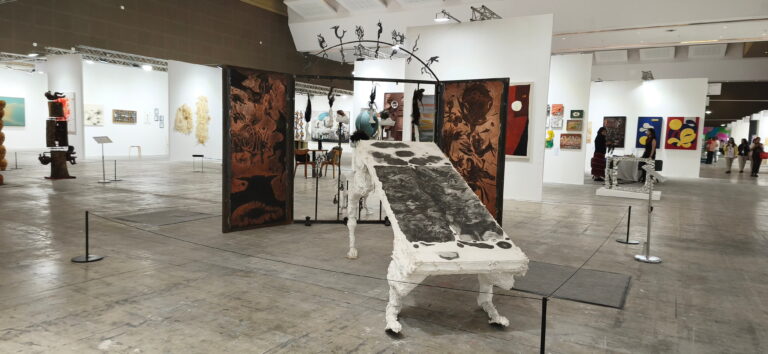
What message does Tale Hazard: Lintasan Cikar convey through its form and surface?
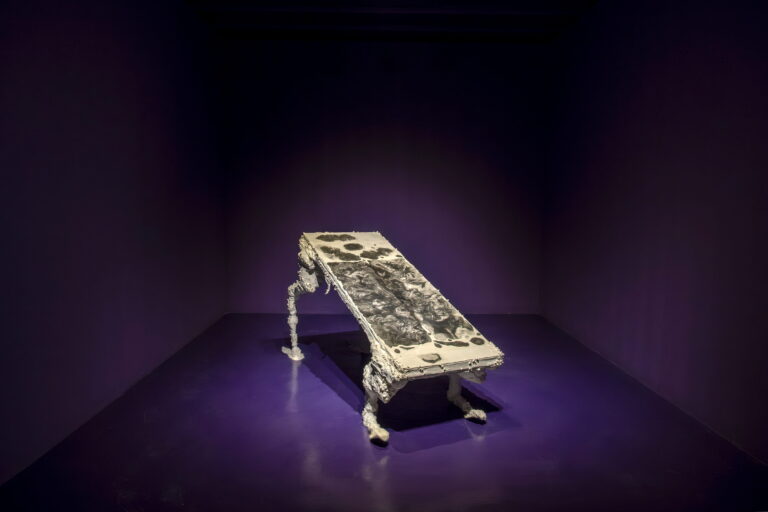
It’s not actually a painting. It’s an intaglio print on gypsum, which is then formed into the sculptural body of a four-legged creature. Through working with intaglio, I’ve become aware of something very important in this delicate process, particularly when using the aquatint technique. These are traces, notes, inks, and time, and a way of making the hidden visible. It’s about connecting traces as they move beyond my hands and tools, from the copper plate and onto the gypsum. These traces are migratory, carrying my actions and uncertainties across different materials.
There’s a connection between traces and tracks. Both carry acts and movement. This is where they begin to echo something else from my past: the tracks of cikar (wooden carts pulled by buffalo) that carried natural resources in my hometown, Blitar. These paths were never fixed. Their functions shifted with political and economic conditions. They were once communal, then taken over and privatised for industrial use, only to reopen when the resources ran out. But the traces remained, scratched into the land.
A track carries more than just goods. We humans risk everything on this track and for this track. It carries our desires, needs, conflicts, and history.
These connections intertwine the act of creation with the act of making sense of how we approach uncertainty. We are always looking for possibilities and potential, while also keeping an eye out for danger. Since we never really know enough, we keep telling each other stories. The prints on the gypsum surface, then, are a reimagining of that tragic history. The sculpture reimagines the cikar as carriers of hope, fear, and history.
How long did the work take to complete?
I didn’t really count how long it took, since the story behind this work has always lived in my memory. But technically, the work took at least six months to complete.
Which details of the completed work are your personal favourites?
I really like all the legs in this constellation of works. They seem vulnerable, but they’re actually holding up a huge mass. Some of them are even my own legs! I used my legs for the life-casting process, so this part always feels very close to me. You can even see the details of the skin.
A Story Still in Motion
For Louise, art is ultimately an act of sharing. Growing up with her grandmother’s stories and folktales taught her the importance of exchanging experiences and listening to others. She approaches artistic recognition with a similar openness, seeing creative pursuits and external judgement as important without necessarily being in conflict.
At Art Jakarta 2026, Louise encourages viewers to look beyond the sculpture’s physical form and uncover the histories carried by its materials. Through the work, she reflects on the paths people leave behind and how art can preserve their traces long after circumstances have changed.